
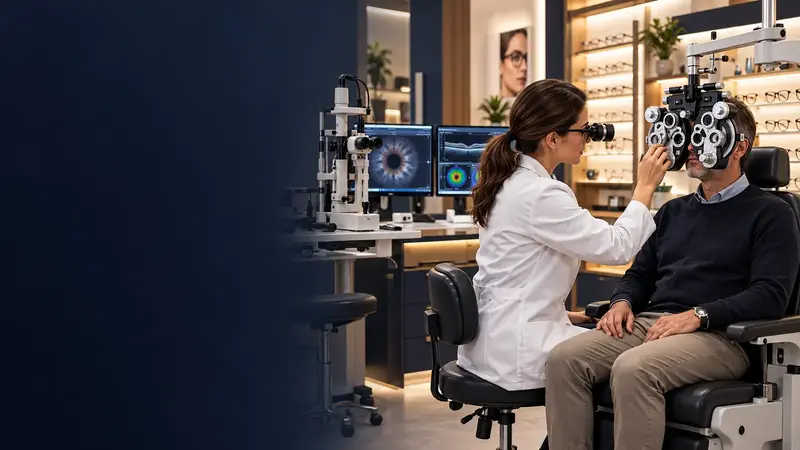
Optical equipment finance for OCT, imaging and testing rooms
Optical equipment finance spreads the cost of OCT scanners, retinal cameras, visual field analysers, refraction units and…

How independent opticians fund an OCT scanner through leasing, hire purchase or a loan, why partial VAT exemption shapes the choice, and a worked example.
“An excellent company that provided funding options quickly.”
In short
What you need to know.
Because sight tests are VAT exempt and spectacle sales are not, most practices recover only part of the VAT on the scanner, which often tilts the choice towards leasing. Lenders look at the private OCT income and the enhanced services the scanner opens up, as well as the practice's profit. We arrange it as a broker, searching the whole market.
About OCT scanner finance
Specialist knowledge. Better outcomes.
It supports private enhanced eye examinations, lets the practice take part in locally commissioned glaucoma and medical eye services, and gives patients a reason to stay rather than drift to a multiple. OCT scanner finance lets the practice pay for the instrument from that income rather than from cash. Smart Funding Solutions is a broker, not a lender. We arrange finance from £10,000 to £20 million by searching the whole market, and this page is part of our optometry practice finance section, alongside the broader optical equipment finance page.
An optical practice makes two kinds of sale. Sight tests and clinical services are exempt from VAT, and spectacles, contact lenses and sunglasses are standard-rated. The practice is therefore partly exempt, and the VAT it can reclaim on an instrument depends on how that instrument is used. An OCT used almost entirely for clinical examinations relates mostly to exempt income, so much of its VAT is a real cost. The partial exemption rules set out how the recoverable share is worked out, and your accountant will know the method your practice uses. In practice that pushes many opticians towards a lease, where the VAT is charged on each rental rather than in one sum at the start, although a practice with a high dispensing share may still prefer hire purchase and the capital allowances that come with it. The Annual Investment Allowance usually covers the whole cost of a scanner bought on hire purchase; asset finance and capital allowances explains the mechanics.
Illustration only, with round hypothetical figures. A two-room independent wants to join a locally commissioned glaucoma referral refinement scheme that requires OCT, and already charges for enhanced examinations using a basic fundus camera. It is quoted £50,000 plus VAT for a combined OCT and fundus camera with progression software, and £4,000 for installation, integration with the practice management system and training. The purchase is arranged like this.
Monthly figures depend on the lender, the deposit and the practice's credit position, which is why we show practices more than one offer before they sign the distributor's paperwork.
New units carry the longest terms and the fullest warranties. Ex-demonstration and refurbished scanners from the manufacturer or an approved distributor are widely financed, usually over a shorter term, and suit a practice adding OCT for the first time. Lenders are cautious about private sales of older units because the software and detectors date quickly and an unsupported scanner has little resale value. If the practice already owns its refraction kit outright, sale and leaseback can release cash towards the scanner. For imaging across healthcare see medical equipment finance, and for older units used equipment finance.
An OCT earns only if patients take up the enhanced examination and the practice is accepted onto the local scheme, so test both before committing to five years of rentals. Check the software licence and service fees, which continue whether or not the finance does, and whether a lease has a secondary rental period that runs on until you give notice. Make sure the VAT cost is in the comparison between buying and leasing. A practice that stacks several instrument agreements can find lenders offer less when it later wants to buy a second practice; see optometry practice acquisition finance. A new practice should read start-up business loans for how an OCT fits into an opening budget.
Lenders fund independent practices trading as limited companies, partnerships and sole traders, including joint venture partners in a franchise or group structure; see joint venture partner finance. The questions they ask are
The last two years of accounts, recent management figures and bank statements, set against existing commitments such as a practice loan, a lease on the refraction equipment and the shop lease.
The share of private OCT examinations patients already take up, and any locally commissioned services the practice can join once it has the instrument. In England, NHS sight tests under General Ophthalmic Services are available to eligible groups, as the NHS sets out, and enhanced services are commissioned locally. In Scotland the NHS eye examination is free to everyone, and in Wales the reformed general ophthalmic services pay practices for a wider range of clinical work. The picture differs by nation, so lenders ask what the practice is paid for now rather than assuming.
Optometrists and dispensing opticians are registered with the General Optical Council, and the College of Optometrists publishes clinical guidance on examination and referral. Lenders do not audit clinical practice, but a practice that can show the scanner is being used within an enhanced service or a referral pathway makes a stronger case. NICE guidance on glaucoma diagnosis and management underpins many of the local referral refinement schemes that require OCT.
Owners are normally asked for a personal guarantee; see our guide to personal guarantees.
How the main business finance structures work. Lenders set their own terms, so treat this as a guide to the questions to ask.
| Option | How you repay | Security | Often used for |
|---|---|---|---|
| Unsecured business loan | Fixed instalments, usually monthly | No charge over assets; a personal guarantee is usually required | Growth, stock, tax bills and cash flow |
| Secured business loan | Fixed instalments, often over a longer term | A charge over property or other assets | Larger sums, property and refinancing |
| Revolving credit facility | Interest on what you draw; repay and redraw | Varies by lender and case | Recurring or uneven cash flow gaps |
| Merchant cash advance | A share of future card takings | No charge over assets | Card-taking businesses with uneven months |
| Asset finance | Regular payments over the life of the asset | The asset being financed | Equipment, vehicles and machinery |
| Invoice finance | Settled as customers pay their invoices | Your unpaid invoices | Businesses waiting on customer payment |
General information only. Every lender has its own criteria, and all finance is subject to status.
| Option | Ownership | Suits | Watch for |
|---|---|---|---|
| Finance lease | The lender's, you rent it | Spreading VAT the practice cannot recover across the rentals, and keeping upfront cost low | Secondary rental periods and end-of-term arrangements |
| Hire purchase | Yours after the final payment | A scanner you will keep for its full life, where you want capital allowances | VAT on the full price at the outset, only partly recoverable for most practices |
| Operating lease | The lender's, which takes the residual value risk | Practices that expect to upgrade to widefield or angiography within a few years | Return conditions, and the scanner is never yours |
| Unsecured loan | Yours from the start | Room works, a refit around the scanner, or a private sale a lender will not secure | Needs a personal guarantee and a healthy trading record |
| Asset refinance | Yours, with a charge to the lender | Raising cash against instruments you already own | Adds a monthly cost to kit already paid for |
Our guides to hire purchase versus leasing and finance lease versus operating lease explain the mechanics. Rates, deposits and terms depend on the lender and the practice, and the distributor's finance is one offer rather than the benchmark.
Send us the quote and a note of what the scanner will be used for. We check how partial exemption affects the comparison for your practice, approach lenders across the market that fund optical equipment, and compare their terms with the distributor's finance. The lender you choose pays the distributor on installation. Any broker fee is disclosed before you proceed. For equipment across all sectors see asset finance and business equipment financing. To see which lenders fit your practice, start with Instant Quotes and tell us the price of the scanner.
Instant OCT scanner finance quotes
Tell us how much you need. Instant Quotes shows which lenders on our panel fit your business, then a broker helps you choose between hire purchase, leasing and a loan.
Prefer to talk it through? Call 01244 267694
Yes, from the manufacturer or an approved distributor, usually over a shorter term than new. Lenders want the unit's age, serial number and software support position, and confirmation that the seller owns it outright.
Usually only part of it. Sight tests are VAT exempt and spectacle sales are standard-rated, so the practice is partly exempt and the recoverable share depends on how the scanner is used. An OCT used mainly for clinical examinations relates mostly to exempt income, which is why many practices lease rather than buy.
Sometimes the distributor's offer is subsidised, and when it is we will say so. More often it is one funder's terms. A broker compares it with lenders across the market on deposit, term, rate and end-of-term conditions, so you decide with the full picture.
It is possible, with a larger deposit and evidence of the owner's experience. Lenders rely on the instrument's resale value, the owner's personal credit and a plan showing where the OCT income comes from. Many new practices add OCT once the patient base is established.
Yes. Lenders are used to joint venture and franchise structures in optics, and will want to see the partnership agreement and any restrictions on equipment purchases. Our page on joint venture partner finance covers the structure.
Often, yes. A modest installation and training charge from the distributor can usually be included in the agreement. Larger room works are funded on a loan or paid from cash.
With accounts, bank statements and the distributor's quote to hand, lenders typically give a decision within days, and the agreement is usually in place before delivery. Joining a commissioned service often takes longer than the finance.
Optical equipment finance spreads the cost of OCT scanners, retinal cameras, visual field analysers, refraction units and…
CBCT scanner finance spreads the cost of a cone beam CT unit over its working life, usually on hire purchase so the practice…

Veterinary CT scanner finance spreads the cost of a CT unit over its working life, most often on hire purchase because…
A loan to buy an optician's practice is usually a term loan for the goodwill, combined with your own deposit and sometimes…

Match the finance to how long each item stays useful. Plotters, survey kit and furniture suit hire purchase because you keep…

Invoice finance works for accountancy firms whose fees are billed to limited companies and other businesses: a provider…
What our clients say
“Simon was fast, kept us updated at all stages and was a real pleasure to work with on our asset finance. I highly recommend this company: excellent service all round.”
“Spoke with Simon, who managed to get me the loan I needed promptly. The whole process was very smooth and was completed within a few days.”
“Getting a business loan can feel like a bit of a minefield, but everything was broken down for me in great detail. Will use again in the future!”
“Simon was a pleasure to deal with and helped us find a business loan that matched our growth goals and future expansion plans.”
“I couldn’t source funding for my business, but the team got in touch within an hour and had it sorted within 24 hours. Fantastic service, and I would definitely use them again.”

Chat with Smart Funding
We usually reply in seconds
Please don't share bank details or passwords here. Calls on 01244 267694.