

Tennis court finance: resurfacing, new courts and floodlights
Tennis court finance covers resurfacing, rebuilding or building new courts, and floodlights. Because a court surface is fixed to the ground and cannot be…
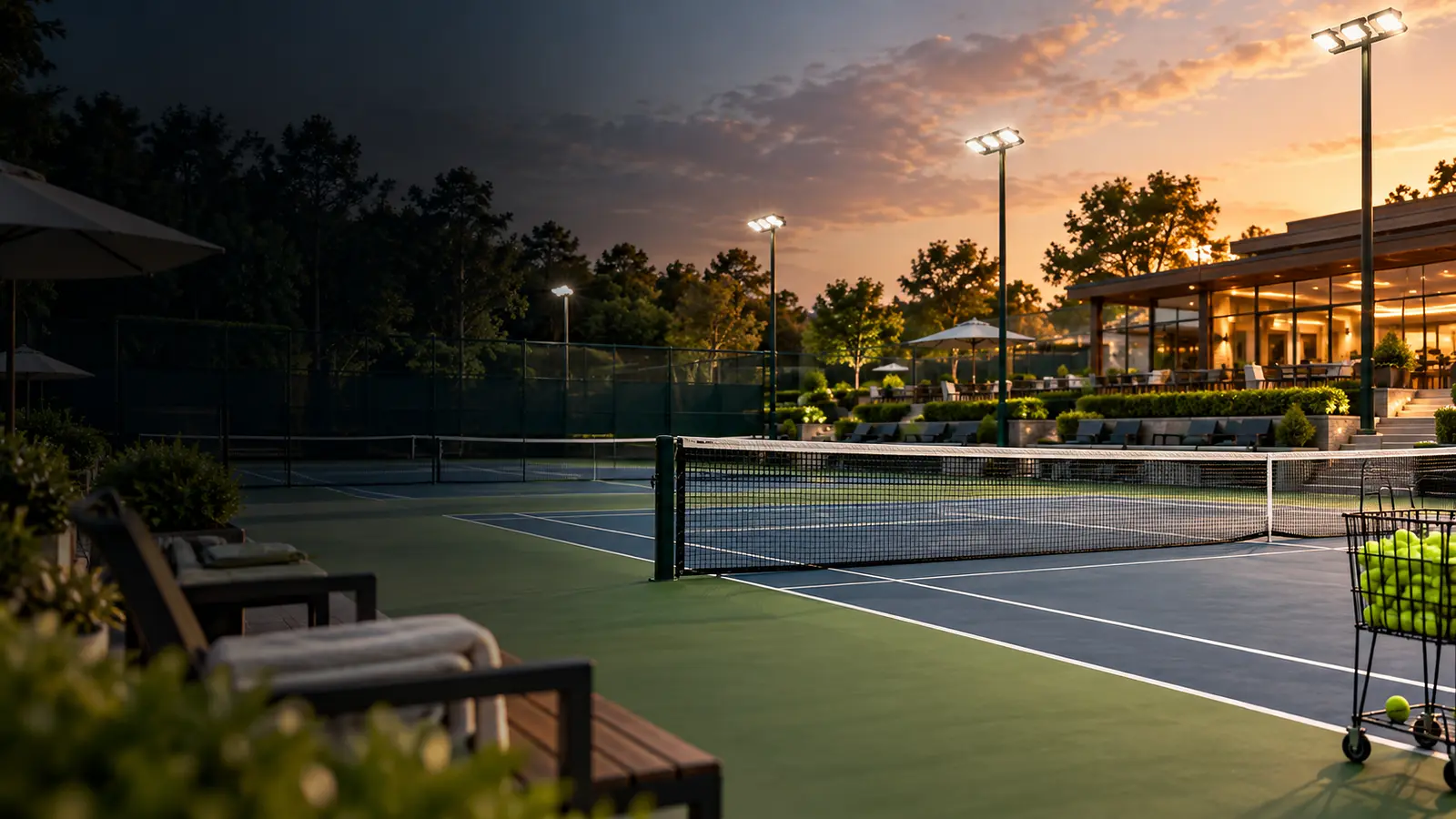
How tennis clubs and centres fund new courts, resurfacing, floodlights, domes and clubhouses, which finance fits each cost, and what lenders look at first.
Explore funding options Prefer a quick call back? Leave your number
“Thank you for all your support.”
In short
Supporting tennis clubs at every stage.
Lenders look most closely at the club's legal structure, its security of tenure on the land, membership and court hire income, and any reserves set aside for resurfacing.
The operating cycle
Cash leaves the business at every stage before it comes back. Each stage below is a point where the right facility can carry the gap.
“He is fair and always gives advice that is in the best interest of his clients.”
Membership subscriptions collected at the annual renewal.
Revolving credit →Court hire, coaching, leagues and pay-and-play.
Dark evenings cut playing hours without floodlights.
Court finance →Outdoor courts lose hours to rain and cold.
Dome finance →Courts wear and need resurfacing on a cycle.
Term loans →Padel courts or a refurbished clubhouse.
Padel court finance →About tennis club finance
Specialist knowledge. Better outcomes.
This page is for people running tennis venues: members' clubs, commercial tennis and racket centres, indoor centres, coaching businesses that operate courts, and hotels, schools and holiday parks with courts let to the public. Smart Funding Solutions is a broker, not a lender: we search a panel of 300+ lenders and arrange facilities from £10,000 to £20 million. This page is part of our leisure business finance guides.
More detail on specific needs within this topic.
Tennis court finance covers resurfacing, rebuilding or building new courts, and floodlights. Because a court surface is fixed to the ground and cannot be…
Tennis dome finance helps clubs and centres cover outdoor courts with an air-supported dome, a framed fabric structure or a permanent building. Air domes and…
Choose the need, and we’ll show you how lenders usually structure it.
Court surfaces are fixed to the land, so lenders treat them as works rather than equipment. They are usually funded with a term loan, a secured loan or a governing body loan. Our page on tennis court finance explains how resurfacing, new courts and floodlights are funded.
An air dome or framed cover turns outdoor courts into year-round courts. Some structures can be taken down and moved, which makes them easier to fund than permanent buildings. See tennis dome finance.
LED floodlight fittings, ball machines, booking and access systems can often be funded on asset finance. Columns set in concrete and cabling are closer to building works.
Many tennis clubs are adding padel courts to bring in new members and court hire income. Padel courts from established manufacturers can be removed and resold, so they are often easier to fund than tennis surfaces. See padel court finance.
Clubhouse refurbishment and extensions are usually funded with a term loan or fit-out finance, with kitchen and bar equipment on asset finance alongside.
Clubs and operators buying their site can look at a commercial mortgage, and clubs that already own their land may be able to use it as security for a secured business loan.
Most tennis clubs earn from membership subscriptions, often collected at an annual renewal, alongside coaching, court hire and pay-and-play, leagues and tournaments, social events and a clubhouse bar. At many clubs coaching is run by a head coach as a separate business that pays the club for court time. Commercial centres rely more on court bookings, memberships and coaching programmes, and indoor centres can trade all year.
The big costs come in lumps. Court surfaces wear and need resurfacing, floodlights need replacing, fencing and nets wear out, and a clubhouse needs periodic refurbishment. Outdoor clubs lose playing hours to rain and dark evenings, which is why many look at floodlights or covered courts. A well-run club builds a sinking fund for these costs, and finance fills the gap when the bill arrives before the fund is large enough.
Not-for-profit tennis venues may be able to use the LTA Facility Loan Scheme, which is aimed at properly constituted, not-for-profit venues and gives priority to covered courts, with floodlit courts and wider community access also considered. Sport England and the other national sports councils run grant programmes for community facilities. These routes are competitive and usually come with conditions about community access, so many clubs combine them with commercial finance or their own reserves. Commercial centres and companies limited by shares are generally not eligible for the LTA scheme.
Many tennis clubs are unincorporated members' clubs, with the land held by trustees. An unincorporated club cannot borrow in its own name, so commercial lenders usually need trustees, a club company or a community benefit society to be the borrower, and fewer lenders will consider it. Clubs registered as a community amateur sports club (CASC) also have rules on how they use their income and assets; see HMRC's CASC guidance. Commercial centres owned by a limited company borrow like any other business.
A loan for resurfacing should be repaid well before the surface needs replacing again, or the club ends up paying for two surfaces at once. Members' clubs should be clear about who carries the liability if the club cannot pay, and proprietors should expect personal guarantees; see our guide to personal guarantees. Test repayments against a cautious membership forecast, and remember that floodlights and domes add running costs as well as income.
Dome finance is the funding a club or centre uses to put a cover over outdoor courts so they can be booked through the winter and in bad weather. The cover can be an air-supported dome, a framed fabric structure or a permanent building, and the type decides how lenders fund it.
Lenders want to see planning consent, the club's security of tenure and a realistic forecast of the extra winter court hire set against heating, power and maintenance. Our pages on tennis dome finance and padel canopy finance go through each type in detail. To see which lenders on our panel fit your project, start with Instant Quotes.
Commercial tennis and racquet centres change hands like other leisure businesses, and buying one is usually funded with acquisition finance: a loan sized on the centre's court hire, coaching and membership income, the buyer's own contribution and sometimes part of the price paid to the seller over time. If the freehold is included, a commercial mortgage can fund the property separately. Lenders look closely at the lease or freehold, the condition and remaining life of the court surfaces and any dome, and whether the head coach and key staff will stay. See working capital after an acquisition for funding the first months under new ownership.
Whether the club owns its land or has a lease that runs well beyond the finance term.
The club's structure, its rules on borrowing and evidence that the borrowing has been approved.
Membership numbers and trends, court hire, pay-and-play and coaching income, and bar income.
Any sinking fund for resurfacing and how much the club is contributing.
Consent for floodlights or a dome, and any conditions on hours or lighting.
A club's legal and tax structure changes what a project really costs and who can borrow for it.
Sports businesses funded on their trading include our case study on a £30,000 term loan for a performance and sports services business.
A registered CASC receives tax reliefs but cannot distribute surpluses to members. Lenders check registration and the club rules on borrowing; see HMRC's CASC guidance notes.
Eligible non-profit clubs can treat sports subscriptions as exempt from VAT, which also limits how much VAT they can recover on new courts or a dome. Lenders size the loan on the VAT-inclusive cost.
LTA loans often fund part of a project, with commercial finance covering the rest. Lenders want the repayment schedules of both to fit the club's income; see the LTA quick access loan scheme.
| Cost | Finance that often fits | Why |
|---|---|---|
| Resurfacing and new courts | Term loan, secured loan or governing body loan | Works fixed to the land, with little security value |
| LED floodlight fittings | Asset finance or a term loan | Depends on how much is equipment and how much is groundworks |
| Air dome or framed cover | Asset finance or a term loan | Depends on the structure and the supplier |
| Padel courts | Asset finance | Removable courts with a used market |
| Clubhouse works | Fit-out finance or a term loan | Spreads costs that cannot be repossessed |
| Buying the site | Commercial mortgage | Long term, secured on the property |
Take a club covering three outdoor courts with a £150,000 air dome package, financed on asset finance over 5 years. The figure is an example, not a price: domes vary with size, specification and site. On our panel, asset finance for £150,000 over 5 years shows 5.27% to 25.25% a year, with a median starting rate of 9.39%.
| Rate | Monthly repayment | Total interest | Total repaid |
|---|---|---|---|
| 5.27% a year (lowest on our panel) | £2,849.28 | £20,956.64 | £170,956.64 |
| 9.39% a year (median starting rate) | £3,142.22 | £38,533.31 | £188,533.31 |
| 25.25% a year (highest on our panel) | £4,424.71 | £115,482.63 | £265,482.63 |
At the median starting rate the dome has to earn about £37,707 a year from winter court hire and extra memberships, roughly £12,569 for each covered court, before heating, power and maintenance. The lowest rates go to established clubs with strong accounts and long security of tenure; a members' club or a newer centre should plan nearer the middle of the range. Foundations, anchoring and groundworks usually sit outside the dome agreement and are paid from reserves, a governing body loan or a term loan. Our asset finance calculator lets you try your own figures. Indicative ranges from lenders on our panel, checked October 2026; your rate depends on your circumstances.
We look at the whole project, split it into the parts different lenders will fund, and check the club's structure before any application goes in. Where a grant or governing body loan covers part of the cost, we can look for commercial finance to sit alongside it. Our sports business funding guide covers grants and sponsorship in more depth. It is free to enquire; any broker fee is disclosed separately before you proceed.
Often, yes, but fewer lenders work with members' clubs than with companies. A club that is a company limited by guarantee or a community benefit society can borrow in its own name; an unincorporated club usually borrows through its trustees. Lenders will want to see the club's rules and approval for the borrowing.
Usually from a mix of a sinking fund, grants or a governing body loan, and a term loan or secured loan for the balance. Because surfaces are fixed to the land, asset finance is rarely used for the surface itself. See tennis court finance.
The LTA runs a Facility Loan Scheme for properly constituted, not-for-profit venues, with priority for covered courts. Check its current criteria on the LTA website. Commercial centres usually need to look at commercial lenders instead.
Often, yes. Padel courts can be removed and resold, so some asset finance lenders will fund them, particularly for a club with accounts and a secure site. See padel club finance.
It is possible but harder than for a trading club. Lenders look for relevant experience, a secure site with planning consent, a credible booking forecast and a meaningful contribution from the owners. See start-up business loans.
Dome finance is borrowing to buy and install a cover over tennis courts, such as an air dome or a framed structure, so the courts can be used all year. Demountable domes can sometimes be funded with asset finance, while groundworks, anchoring and electrics are usually funded with a term loan. See tennis dome finance.
Yes, but the length and terms of the lease matter a great deal. Lenders usually want the lease to run well beyond the end of the loan, especially for court building or a dome fixed to the land, and some will ask for the landlord's consent to the works. A short or rolling lease limits borrowing to shorter terms or equipment the club could remove.
It depends on the price of the dome and the rate you are offered. As an example, £150,000 on asset finance over 5 years is £3,142.22 a month at 9.39%, the median starting rate on our panel for that size and term, or £2,849.28 to £4,424.71 a month across the full panel range of 5.27% to 25.25% a year. Indicative ranges from lenders on our panel, checked October 2026; your rate depends on your circumstances.
Most asset finance products on our panel run for up to 5 or 7 years. Lenders keep the term within the working life of the dome or lights, and want the club's lease or ownership of the site to run well beyond the end of the agreement.
If a dome or cover supplier offers a payment plan, or finance through a partner, ask for the total repayable, the term and what happens at the end, and set it against other offers before you sign. We search the market across lenders on our panel, so you can compare a supplier's plan with independent asset finance and term loans.
Yes. LED fittings can often be funded on asset finance, while columns set in concrete and the cabling are closer to building works and are usually funded with a term loan or from reserves. Lenders will ask for planning consent and any conditions on lighting hours.
Football club finance usually combines a term loan or secured loan for 3G pitches and building works, asset finance for…
Padel club finance usually combines asset finance for the courts, lighting and any canopy, a term loan or fit-out facility for…
Sports club loans usually combine a term loan or secured loan for clubhouse and pitch works, asset finance for machinery and…
Rugby club finance usually combines asset finance for floodlight fittings, machinery and minibuses with a term loan or secured…
Golf club finance usually combines asset finance for buggies, greenkeeping machinery and range technology, a term loan or…
Padel court finance spreads the cost of courts over several years, usually through hire purchase or leasing secured on the…
What our clients say
“Simon was fast, kept us updated at all stages and was a real pleasure to work with on our asset finance. I highly recommend this company: excellent service all round.”
“Spoke with Simon, who managed to get me the loan I needed promptly. The whole process was very smooth and was completed within a few days.”
“Getting a business loan can feel like a bit of a minefield, but everything was broken down for me in great detail. Will use again in the future!”
“Simon was a pleasure to deal with and helped us find a business loan that matched our growth goals and future expansion plans.”
“I couldn’t source funding for my business, but the team got in touch within an hour and had it sorted within 24 hours. Fantastic service, and I would definitely use them again.”