

Combine harvester finance for farms and contractors
Most farms buy a combine on hire purchase, often with a balloon to reduce instalments, because they keep the machine for years…
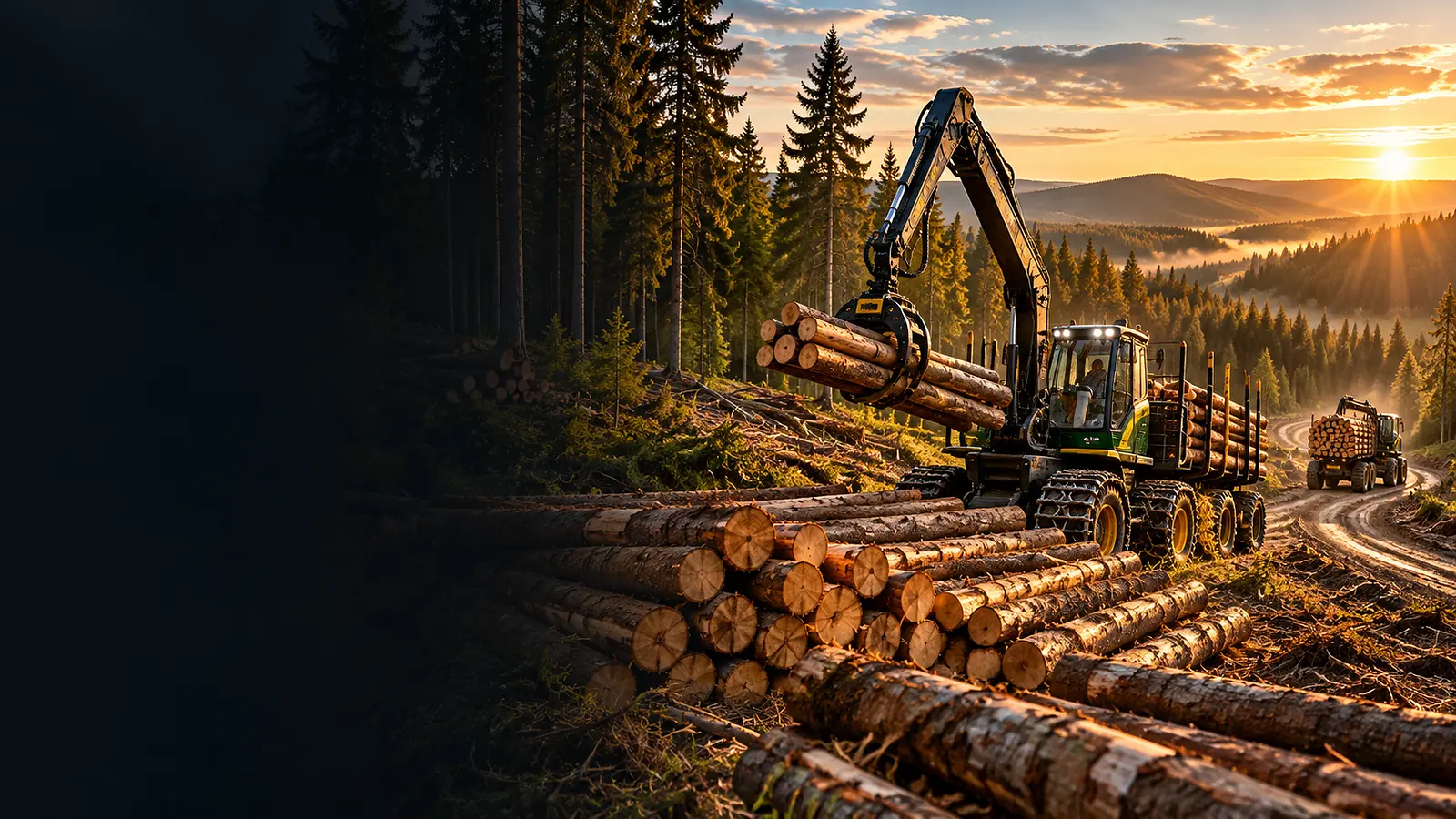
How forestry contractors, sawmills, firewood producers and woodland owners fund machinery, standing timber and planting, and what lenders check.
Explore funding options Prefer a quick call back? Leave your number
“The deal we received was exactly what we needed.”
In short
Supporting forestry businesses at every stage.
Harvesting contractors mostly use asset finance on forwarders, harvesters and timber lorries; sawmills and firewood processors add working capital for log stock and kilns; woodland owners borrow against land and plan around long rotations, felling licences, grants and carbon income. Lenders focus on machine resale values, the reliability of contract work, and evidence of timber volumes and access.
The operating cycle
Cash leaves the business at every stage before it comes back. Each stage below is a point where the right facility can carry the gap.
“He is fair and always gives advice that is in the best interest of his clients.”
Orders, contracts or customers secured.
Stock, materials and equipment paid for up front.
Asset finance →Wages and suppliers paid on time.
Working capital →The work is done or the goods are sold.
Customers pay, sometimes weeks later.
Invoice finance →VAT and Corporation Tax fall due.
HMRC loans →Growth, a new site or new equipment.
Business loans →About forestry finance
Specialist knowledge. Better outcomes.
Forestry income is lumpy in a way few other rural businesses match: a conifer crop may take decades to reach clearfell, a contractor's work depends on felling programmes set by managers and buyers, and a sawmill pays for logs long before it is paid for fencing or sawn timber. This page covers finance for harvesting and haulage contractors, sawmills, firewood and biomass processors, and owners of commercial woodland. Smart Funding Solutions is a broker, not a lender: we search our panel of 300+ lenders for facilities from £10,000 to £20 million. For general farm borrowing, see our agricultural finance and farm loans hub.
Choose the need, and we’ll show you how lenders usually structure it.
The contractor's capital sits in a small number of very expensive machines: a harvester, a forwarder, sometimes a mulcher or excavator with a felling head, plus low-loaders to move them between sites. A single breakdown stops income completely, so finance needs often arrive at short notice when a head, crane or transmission fails. Work comes from forest management companies, estates and timber merchants, and a contractor who works mainly for one of them carries real concentration risk.
Businesses that buy standing timber pay the woodland owner up front or in instalments, then fell, extract and sell to sawmills, board mills or biomass plants. The gap between paying for a parcel and being paid for the last load can be months, and it widens if wet ground stops extraction. Timber lorries with cranes are specialist vehicles that fewer lenders know well.
Mills carry log yards, kilns, saw lines, treatment plant and stock of sawn timber waiting for customers in fencing, construction and landscaping. Firewood businesses need processors, kilns and dry storage, and in England wood sold in small quantities for domestic burning must meet the Ready to Burn moisture standard, which in practice means kiln capacity or long seasoning. Both are working-capital heavy and seasonal: firewood sells in autumn and winter, fencing and garden timber in spring and summer.
Estates, farms and investors plant new woodland, restock after felling or restructure diseased plantations. Ash dieback and larch disease have forced unplanned felling on many holdings, bringing timber income forward but leaving restocking costs behind it. Planting is often part-funded by grants such as the England Woodland Creation Offer, and some schemes register with the Woodland Carbon Code to sell carbon units, but both pay in stages and the owner funds the work first.
Illustration (a made-up example in round numbers; no rates implied). A two-machine harvesting contractor's forwarder suffers a major failure with three sites booked for the winter. A used replacement costs around £150,000. The contractor's harvester is already on hire purchase with eighteen months to run. A lender funds the forwarder on a new agreement, valuing it on hours and an independent inspection, and the old machine is sold for parts to reduce the deposit. Booked work from two management companies supports affordability, so the harvester agreement is left in place rather than refinanced.
Forestry's risks are physical and market-driven. Storms can flood the market with windblown timber and depress prices; wet winters halt extraction while finance payments continue; mill demand follows construction activity. Machine finance is secured on the machine, and directors are commonly asked for personal guarantees. Before borrowing, consider hiring a machine for a peak contract, subcontracting extraction, selling standing rather than at roadside to pass harvesting risk to the buyer, or phasing planting over several grant rounds. For woodland owners, selling carbon units or entering a joint venture with an investor can fund planting without debt. Owners turning woodland into a visitor or event business should read our farm diversification finance page.
Specialist forestry machines have an active second-hand market, often international, but values fall sharply with hours. Lenders ask for hours, the condition of heads and cranes, and the supplier.
A schedule of booked sites, framework agreements with management companies and a spread of customers show where the next year's income comes from.
For timber purchases and woodland lending, lenders check that felling is approved. In England most felling needs a licence from the Forestry Commission unless an exemption applies; GOV.UK explains when a felling licence is needed.
Woodland with poor road access, steep slopes or soft ground costs more to harvest and is worth less as security. Rights of way for timber lorries are reviewed on title.
Licences usually carry conditions to replant. Owners must budget for it, and lenders treat it as a liability against the timber income.
Profits from occupying commercial woodland are generally outside income and corporation tax, while sawmilling and contracting are taxed as ordinary trades. Accounts that mix the two need explaining.
| What needs funding | Route lenders commonly consider | Watch for |
|---|---|---|
| Harvesters, forwarders, tracked machines | Hire purchase or asset finance, including used equipment finance for imported or high-hour machines | Hours, service history and brand drive the lender's view; shorter terms for heavily worked kit |
| Timber lorries and low-loaders | Commercial vehicle hire purchase, alongside an operator's licence | Crane and body valued separately from the chassis |
| Releasing cash from owned machines | Asset refinancing | Adds secured debt to machines already earning |
| Saw lines, kilns, processors | Asset finance on plant and machinery, with landlord waivers where buildings are rented | Fixed plant is harder to recover and resell |
| Standing timber purchases and log stock | A working capital loan or revolving facility; invoice finance for mill customers on credit terms | Repayment depends on extraction weather and sale prices |
| Buying woodland | A loan secured on land through land finance, with a larger deposit than farmland usually needs | Low annual income relative to value limits what can be serviced |
Some will, particularly for well-known brands with a UK dealer network for parts and service. Expect the lender to ask for an independent inspection, proof of ownership from the seller and confirmation that the machine meets UK requirements before payment is released.
Timber growing on land forms part of the land, so lenders normally take security over the woodland itself rather than the trees alone. A buyer of standing timber usually funds the purchase from working capital or a short-term facility repaid as loads are sold.
Yes for equipment: chippers, stump grinders, tracked carriers and tipper vehicles are commonly funded on hire purchase. The income profile differs from forestry, being driven by domestic and council work, and grounds businesses are covered on our grounds maintenance finance page.
Often yes. Replacing or repairing a harvester or forwarder can be funded within a few working days in straightforward cases, particularly where the contractor has a good record with asset finance lenders. A replacement machine can usually go on hire purchase, while a major repair may suit a short-term loan. Keeping up-to-date accounts and a list of current agreements ready makes a fast application easier. Our used equipment finance page covers second-hand machines.
It can. A forestry contractor who earns most of their income from one forest management company, estate or timber merchant carries concentration risk, and lenders take that into account. It does not usually stop asset finance, because the machine secures the agreement, but it can affect the term, deposit or amount offered. Showing a long working relationship, contracts or a forward felling programme helps reassure a lender.
Yes. Buying an established forestry, harvesting or tree surgery business is usually funded with acquisition finance: a loan sized on the business's recent profits, your own contribution and sometimes part of the price paid to the seller after completion. Lenders look most closely at the contracts and customer spread, the machinery and its finance, and whether the operators and certificates go with the business. You can see which lenders on our panel fund purchases like yours with Instant Quotes.
Most farms buy a combine on hire purchase, often with a balloon to reduce instalments, because they keep the machine for years…

Agricultural land finance helps a farm business buy more land, usually with an agricultural mortgage secured on the new land…

Count the hours. A tractor that will work most of the year is usually best bought on hire purchase, so the farm owns it at the…
Crop finance covers the gap between autumn drilling and the sale of the harvest, which on a combinable crop farm can be the…
Farm diversification finance funds a new, non-farming income stream on the holding: barn conversions to workshops or homes,…
Agricultural equipment finance spreads the cost of farm machinery, from drills and sprayers to telehandlers, feed wagons and…
What our clients say
“Simon was fast, kept us updated at all stages and was a real pleasure to work with on our asset finance. I highly recommend this company: excellent service all round.”
“Spoke with Simon, who managed to get me the loan I needed promptly. The whole process was very smooth and was completed within a few days.”
“Getting a business loan can feel like a bit of a minefield, but everything was broken down for me in great detail. Will use again in the future!”
“Simon was a pleasure to deal with and helped us find a business loan that matched our growth goals and future expansion plans.”
“I couldn’t source funding for my business, but the team got in touch within an hour and had it sorted within 24 hours. Fantastic service, and I would definitely use them again.”