
Loan to buy an optician's: funding an optical practice purchase
A loan to buy an optician's practice is usually a term loan for the goodwill, combined with your own deposit and sometimes…
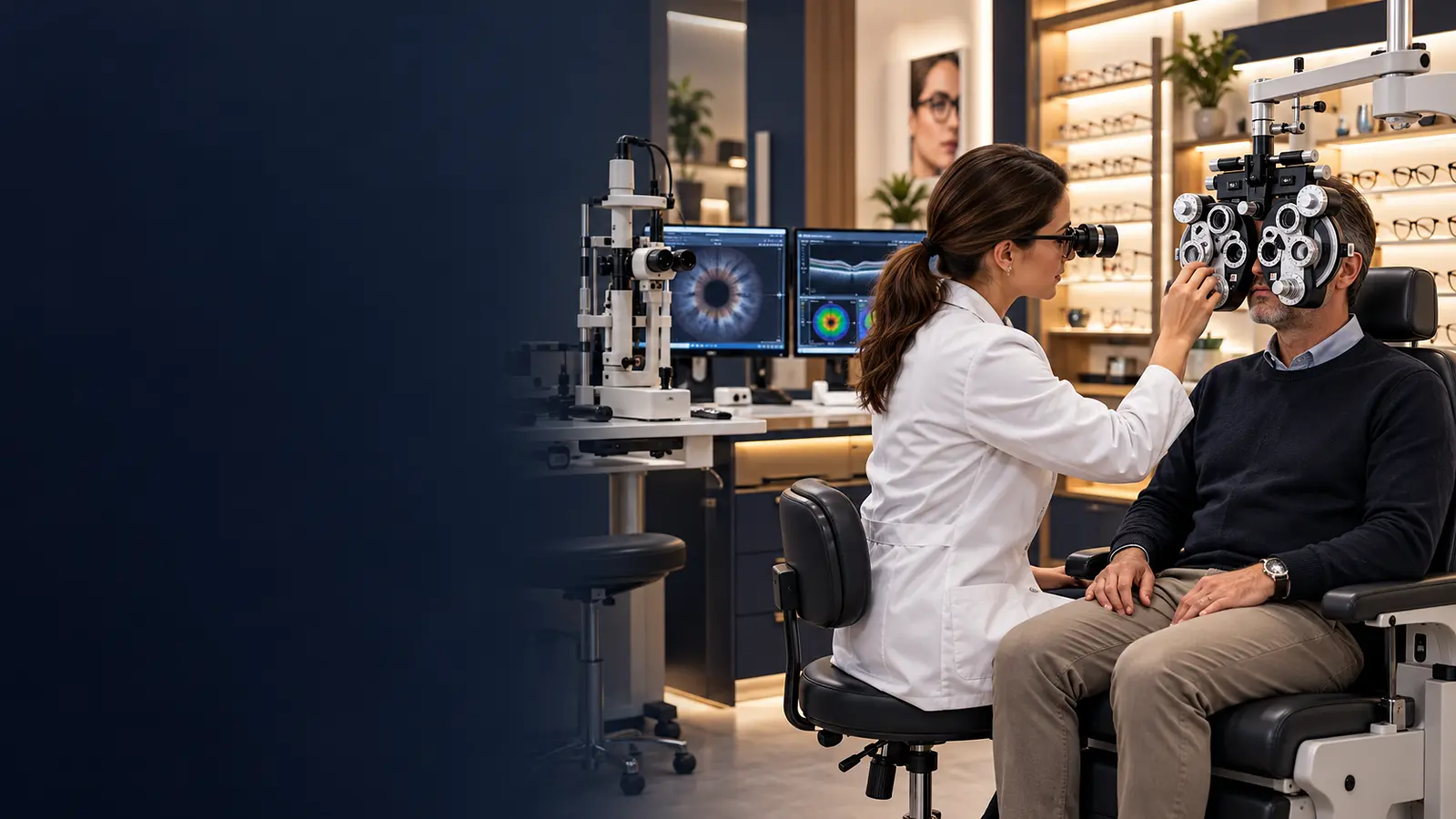
How independent opticians fund OCT scanners, retinal imaging, refraction units and edging labs, and why the VAT position often decides lease or purchase.
Explore funding options Prefer a quick call back? Leave your number
“An excellent company that provided funding options quickly.”
In short
What you need to know.
Because sight tests are VAT-exempt, most practices cannot reclaim all the VAT on clinical kit, which often tips the choice towards leasing. Lenders look at practice profit, the supplier's quote and whether the equipment has a resale market.
About optical equipment finance
Specialist knowledge. Better outcomes.
This page is for independent optometrists, dispensing opticians and small optical groups buying clinical or laboratory equipment: a first OCT scanner, a replacement slit lamp, a digital refraction unit for a second testing room, or an in-house edging lab. Smart Funding Solutions is a broker, not a lender. We search our panel of 300+ lenders and approach those that fund optical kit, arranging facilities from £10,000 to £20 million. For other ways practices borrow, see our optometry finance hub.
The testing room has changed faster than the shop floor. Ten years ago a well-equipped independent had a slit lamp, a tonometer and a fundus camera. Today the kit that decides whether a practice can take on extended clinical work looks more like this:
The reason this matters to a lender is income. Locally commissioned services such as minor eye conditions, glaucoma referral refinement and post-cataract checks usually require OCT or fields, and they pay per episode. A practice that can show the kit opens a new income line, or moves private OCT add-ons from occasional to routine, has a much stronger case than one replacing a working instrument because a rep called.
This is where optical practices differ from most equipment buyers. Sight tests by a registered optometrist are exempt from VAT, the dispensing service element of spectacles is also exempt, while frames and lenses as goods are standard-rated. HMRC sets this out in VAT Notice 701/57 on health professionals. The result is that most practices are partly exempt and cannot reclaim all the VAT they pay.
An OCT used almost entirely for clinical examinations will mostly relate to exempt income, so much of its VAT is a real cost. On hire purchase that VAT is charged up front on the whole price; on a lease it is charged on each rental, so the unrecoverable part is spread over the term rather than paid in one go. Your accountant should confirm your recovery position under HMRC partial exemption rules before you choose. Ownership also affects tax relief: hire purchase normally lets the business claim capital allowances, such as the Annual Investment Allowance, while lease rentals are generally deducted as an expense. Our article on asset finance and capital allowances explains the difference.
Illustration only, with round hypothetical numbers. A two-room independent wants to join a local glaucoma referral refinement scheme that requires OCT. The quote is £40,000 for a combined OCT and fundus camera, plus £5,000 for installation, software integration and staff training. A lender might fund the instrument on a lease over five years, with the installation and training on a small unsecured loan or paid from cash. The application is stronger if the practice can show the expected number of commissioned episodes, the private OCT uptake it already achieves with a basic camera, and that the monthly cost is comfortably covered by current profit even if the scheme takes a year to build up.
Match the term to how long the kit will stay clinically current, not to the lowest monthly payment. A seven-year agreement on imaging you expect to upgrade in five leaves you paying for an instrument you no longer want. Service contracts and software licences are often outside the finance and add to the monthly cost. Personal guarantees are usual, so read our guide to personal guarantees before signing.
Alternatives are worth weighing. Refurbished instruments from a reputable distributor can be funded through used equipment finance. Some buying groups negotiate member pricing that changes the sums. And if a new service has not been commissioned in your area, waiting may be wiser than borrowing. For broader clinical kit questions, our medical equipment finance page compares how lenders treat diagnostic devices across healthcare.
Recent accounts and bank statements showing the payment fits alongside rent, wages, existing finance and frame stock purchases.
An established optical distributor, a full specification and a clear split between the instrument, software and installation.
Mainstream OCT, fields and slit lamps have a second-hand market; practice-specific software and room works do not, so lenders may treat them as unsecured.
Commissioned services, private imaging fees or extra testing capacity the kit creates.
Older leases still running on kit being replaced, and any settlement figures.
Who owns the practice, GOC registration of the clinicians and, for a company, the directors.
Business and personal credit files; directors are commonly asked to guarantee.
How the main business finance structures work. Lenders set their own terms, so treat this as a guide to the questions to ask.
| Option | How you repay | Security | Often used for |
|---|---|---|---|
| Unsecured business loan | Fixed instalments, usually monthly | No charge over assets; a personal guarantee is usually required | Growth, stock, tax bills and cash flow |
| Secured business loan | Fixed instalments, often over a longer term | A charge over property or other assets | Larger sums, property and refinancing |
| Revolving credit facility | Interest on what you draw; repay and redraw | Varies by lender and case | Recurring or uneven cash flow gaps |
| Merchant cash advance | A share of future card takings | No charge over assets | Card-taking businesses with uneven months |
| Asset finance | Regular payments over the life of the asset | The asset being financed | Equipment, vehicles and machinery |
| Invoice finance | Settled as customers pay their invoices | Your unpaid invoices | Businesses waiting on customer payment |
General information only. Every lender has its own criteria, and all finance is subject to status.
| Option | When it suits | Trade-off |
|---|---|---|
| Hire purchase | Kit you will keep for its full life, such as a slit lamp or visual field analyser | VAT is usually payable at the start; you own it at the end |
| Finance lease | Imaging that dates quickly and may be swapped at the end of the term | You never own it outright; ending early can be expensive |
| Supplier or manufacturer finance | A single instrument with a promotional offer from the distributor | Ties you to that supplier's price; compare the cash price elsewhere |
| Unsecured loan | Installation, software, room alterations and kit too small or mixed to secure | Usually a personal guarantee; shorter term than asset finance |
| Asset refinancing | Releasing cash from kit you already own outright | Adds a new monthly commitment to equipment that has already been paid for |
Our guide to hire purchase versus leasing explains the mechanics in more depth, and our asset finance page covers how lenders structure deposits, balloons and terms.
If you are buying a practice and need to re-equip it, our optical practice acquisition finance page covers the purchase itself, and partners in a joint-venture store should read our optical joint-venture partner finance page. It is free to enquire; any broker fee is disclosed separately before you proceed.
Often, yes. Lenders on our panel will consider used optical equipment from an established distributor, usually with a shorter term reflecting its age. Ask for the service history, the software version and whether the manufacturer will still support it, because a lender will want the same reassurance.
They are normally financed as separate agreements, because a van and a portable slit lamp have different lives and resale markets. The vehicle can go through vehicle finance and the instruments on hire purchase or a lease.
Some lenders will include modest installation and training costs within an equipment agreement when they are on the supplier's invoice; others will only fund the instrument itself. Where the soft costs are large, a small unsecured loan alongside the asset finance is a common answer.
Sometimes. A promotional offer can be good value, but it only applies to that supplier's kit and price. Compare the total cost against the cash price you could negotiate elsewhere with independent finance before deciding.
Often, yes, because the equipment itself acts as security, which makes asset finance one of the more accessible forms of funding for a new practice. Lenders still look at the owners' experience, the business plan, the deposit available and personal credit, and may ask for personal guarantees. Equipment with a strong resale market is easier to fund. See our page on start-up business loans for wider start-up funding.
A loan to buy an optician's practice is usually a term loan for the goodwill, combined with your own deposit and sometimes…
Dental equipment finance spreads the cost of chairs, OPG and CBCT imaging, intraoral scanners and decontamination equipment…
Veterinary equipment finance spreads the cost of digital X-ray, ultrasound, CT, anaesthesia and monitoring, dental units, lab…
Optical franchise finance usually means funding a joint-venture partner's buy-in: the price of shares in a store company you…

Match the finance to how long each item stays useful. Plotters, survey kit and furniture suit hire purchase because you keep…
Dental surgery refurbishment finance funds the building works, services and equipment needed to refit surgeries, add a…
What our clients say
“Simon was fast, kept us updated at all stages and was a real pleasure to work with on our asset finance. I highly recommend this company: excellent service all round.”
“Spoke with Simon, who managed to get me the loan I needed promptly. The whole process was very smooth and was completed within a few days.”
“Getting a business loan can feel like a bit of a minefield, but everything was broken down for me in great detail. Will use again in the future!”
“Simon was a pleasure to deal with and helped us find a business loan that matched our growth goals and future expansion plans.”
“I couldn’t source funding for my business, but the team got in touch within an hour and had it sorted within 24 hours. Fantastic service, and I would definitely use them again.”