
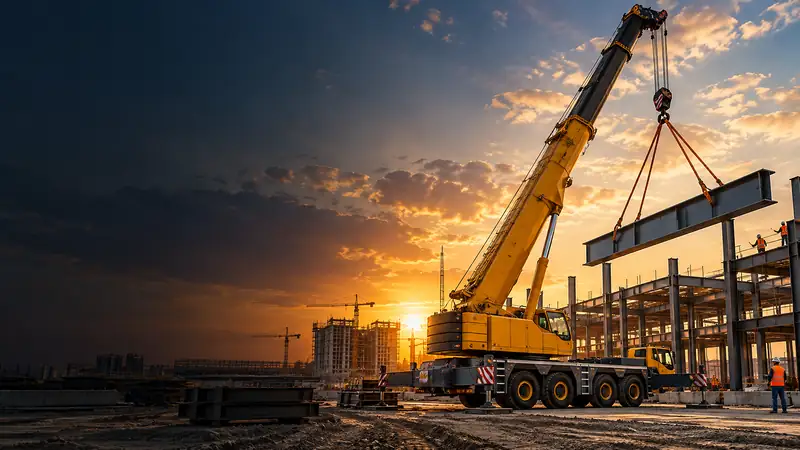
Crane finance for hire companies and lifting contractors
Crane finance spreads the cost of a mobile, crawler, tower or lorry-loader crane over monthly payments, usually through hire…
How contractors and plant hire firms finance excavators, cranes, crushers and whole fleets, and how lenders judge hours, residuals and utilisation.
Explore funding options Prefer a quick call back? Leave your number
“I highly recommend this company: excellent service all round.”
In short
What you need to know.
Lenders value plant on make, hours, service history and emissions standard, then check that contracts or hire utilisation will cover the payments. Fleet owners can often agree a single credit line and draw it machine by machine rather than applying each time.
A transaction we arranged
£185,000
The machine could increase capacity. Paying £185K in cash would have reduced it.
An engineering firm wanted a new CNC machine without draining working capital. We arranged asset finance against the machine.
Read the transactionAbout plant finance
Specialist knowledge. Better outcomes.
This page is for groundworks and civil engineering contractors, demolition and earthmoving firms, plant hire companies, quarry and aggregate operators, and recyclers who run heavy plant as the core of how they earn. Smart Funding Solutions is a broker, not a lender: we approach plant finance specialists and asset finance lenders on our panel of 300+, for facilities from £10,000 to £20 million. It is part of our asset finance range. For production machinery such as CNC and presses, see machinery finance, and for a machine-by-machine view of site kit, our construction equipment guide.
For lifting and site transport, see our pages on crane finance, cherry picker finance and tipper truck finance.
For most contractors the first question is not how to finance a machine but whether to own it at all. Ownership pays when the machine works most weeks; hiring in pays when demand is patchy, because the hire company absorbs idle time, servicing and breakdowns.
Illustration only, with round hypothetical figures. A groundworks firm hires in a 13-tonne excavator at £1,000 a week and has needed one for about 40 weeks of each of the last two years, so it is spending roughly £40,000 a year on hire. Buying a similar used machine for £90,000 on hire purchase would mean monthly finance payments plus insurance, servicing, transport and some repairs. If those ownership costs come to meaningfully less than £40,000 a year, and the machine will still have a resale value at the end, owning is likely to win. If the firm only needed a machine for 15 weeks, hire would be cheaper. Lenders find this comparison persuasive because it shows the payments are replacing an existing cost rather than adding a new one.
Plant is one of the easiest asset classes to fund, because it has deep dealer, auction and export markets. That does not make every machine equal.
Attachments such as breakers, tiltrotators, buckets and crusher buckets can usually go on the same agreement if they are on the dealer's invoice. Used and auction machines are widely funded, though lenders need clear title and may shorten the term on high hours; our used equipment finance page explains how.
The most common mistake is over-fleeting: financing machines on the strength of one good year, then carrying payments through a quieter one. Balloon payments are a second trap, because they assume a resale value that falls if the market softens or emissions rules move on. When several agreements sit with one lender, they are often linked, so a problem on one machine can put the whole fleet in question. Directors are usually asked for personal guarantees, and a missed payment on a machine that has been stolen or damaged is still a missed payment, so check insurance cover and excess levels before signing.
VAT on a hire purchase is recoverable for most VAT-registered contractors, but it is still cash out of the business until the next return. Some lenders will fund it over a few months. And sometimes the right answer is to keep hiring in, or to buy a good used machine rather than a new one.
A plant hire firm is judged differently from a contractor, because its income comes from renting the machines out rather than using them. Lenders ask for:
, showing how many days a year each category is on hire and at what rates.
, since a hire firm dependent on one main contractor carries that contractor's risk.
Operated hire earns more per day but carries operator wages and higher liability, so margins and insurance differ.
and the replacement plan, so the lender can see the business is not running a fleet that will all need replacing at once.
, because hire is invoiced on account and construction customers pay slowly. Where this strains cash, invoice finance can sit alongside the asset facilities.
Contractors, by contrast, are assessed on their order book, contract terms, retentions and how the new machine fits the work; our construction finance page covers that side.
How the main business finance structures work. Lenders set their own terms, so treat this as a guide to the questions to ask.
| Option | How you repay | Security | Often used for |
|---|---|---|---|
| Unsecured business loan | Fixed instalments, usually monthly | No charge over assets; a personal guarantee is usually required | Growth, stock, tax bills and cash flow |
| Secured business loan | Fixed instalments, often over a longer term | A charge over property or other assets | Larger sums, property and refinancing |
| Revolving credit facility | Interest on what you draw; repay and redraw | Varies by lender and case | Recurring or uneven cash flow gaps |
| Merchant cash advance | A share of future card takings | No charge over assets | Card-taking businesses with uneven months |
| Asset finance | Regular payments over the life of the asset | The asset being financed | Equipment, vehicles and machinery |
| Invoice finance | Settled as customers pay their invoices | Your unpaid invoices | Businesses waiting on customer payment |
General information only. Every lender has its own criteria, and all finance is subject to status.
| Structure | How it works | Suits | Watch for |
|---|---|---|---|
| Hire purchase | Deposit, fixed instalments, ownership at the end | Core machines you will run for many years | VAT on the price is usually payable at the start |
| Hire purchase with a balloon | Lower instalments with a larger final payment set against expected resale value | Well-known makes with strong residuals, or plant you will trade in at a set point | If values fall, the balloon can exceed what the machine is worth |
| Seasonal or stepped payments | Payments reduced or paused in agreed months | Businesses with a predictable quiet season, such as some earthmoving and agricultural contracting | Total cost is higher; fewer lenders offer it |
| Finance lease | The lender owns the machine; you rent it for most of its life | Keeping upfront cost down while controlling the machine | You do not take legal title |
| Fleet credit line | A pre-agreed limit drawn as each machine is bought | Plant hire firms and larger contractors buying several machines a year | Annual reviews; all agreements may be linked |
| Sale and hire purchase back | A lender buys owned plant and sells it back to you in instalments | Raising cash from machines already paid for | Adds borrowing against assets that were free of finance |
The accounting and ownership differences between these agreements are set out in our guide to hire purchase versus leasing.
Send us the quote or the machine details, your fleet list and recent figures. We look at whether the machine should be owned, leased or refinanced, approach lenders on our panel that fund that class of plant, and compare terms, including balloons, seasonal payment options and any link to your existing agreements. The lender makes the decision and pays the dealer or seller once the machine is delivered and checked. It is free to enquire; any broker fee is disclosed separately before you proceed.
Illustrative figures from the numbers you enter, before you speak to a lender.
It is possible, but lenders will lean on the directors' experience in plant hire or construction, personal credit, a deposit and evidence of demand such as letters from contractors who intend to hire. Starting with mainstream machines that have strong resale values makes lenders more comfortable. Expect personal guarantees and possibly shorter terms until the business has a trading record.
Yes, though a lease or a shorter hire purchase with a planned sale at the end often fits better than a long agreement. Lenders will want to see the contract and a realistic view of what the machine will be worth when it finishes. If the contract is short, compare the cost with long-term hire before committing.
Lenders fund them in the same way, and they have strong resale markets. See our pages on forklift finance and telehandler finance for the points specific to those machines.
Yes. Mobile crushers, screeners, shredders and material handlers are widely financed, although heavy-wear equipment is valued with care and service records matter. Operators need the relevant environmental permits in place, and lenders will ask about them. Our waste and recycling finance page covers that sector.
Plant finance with a poor credit history is possible, because the machine itself secures the agreement and holds its value well. Lenders will still look at the reason for the credit problems, whether they are settled and how the business trades now. Expect a larger deposit, a shorter term or a higher cost than a clean case. Our guide to bad credit asset finance explains what lenders look for.
Crane finance spreads the cost of a mobile, crawler, tower or lorry-loader crane over monthly payments, usually through hire…
Cherry picker finance spreads the cost of a mobile elevating work platform, such as a van-mounted boom, self-propelled boom,…
Skip lorry finance spreads the cost of skip loaders, hook loaders and the skips and containers they carry over monthly…

Business hire purchase is a way to buy a vehicle, machine or piece of equipment over time. A lender buys the asset, you pay a…
Hire purchase is buying an asset in instalments: you claim capital allowances and own it after the last payment, but VAT on the…
Minibus finance spreads the cost of a 9 to 16 passenger minibus over monthly payments, through hire purchase, a finance lease…
What our clients say
“Simon was fast, kept us updated at all stages and was a real pleasure to work with on our asset finance. I highly recommend this company: excellent service all round.”
“We were looking for finance for new equipment. Simon is excellent and objective-driven, without the horrendous form filling of your usual high street bank. The whole thing took just a few days.”
“Spoke with Simon, who managed to get me the loan I needed promptly. The whole process was very smooth and was completed within a few days.”
“Getting a business loan can feel like a bit of a minefield, but everything was broken down for me in great detail. Will use again in the future!”
“Simon was a pleasure to deal with and helped us find a business loan that matched our growth goals and future expansion plans.”
“I couldn’t source funding for my business, but the team got in touch within an hour and had it sorted within 24 hours. Fantastic service, and I would definitely use them again.”