
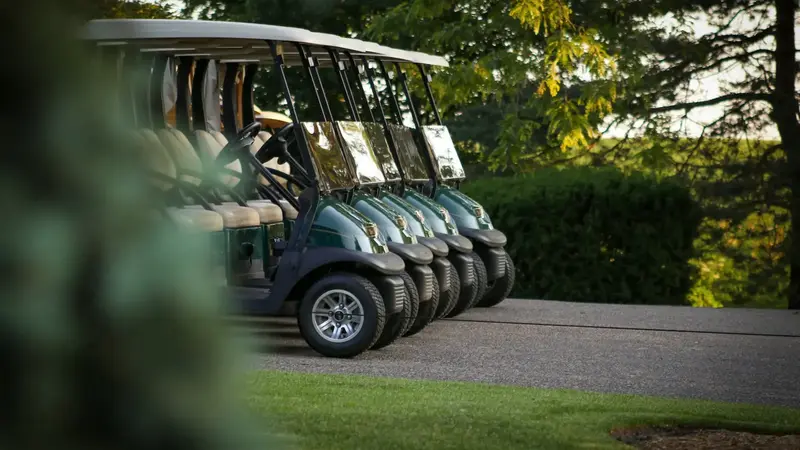
Golf buggy finance: funding a new or used buggy fleet
Golf buggy finance spreads the cost of a buggy fleet over several years, usually through hire purchase or leasing secured on…
How golf clubs finance greenkeeping machinery such as fairway and greens mowers, tractors and sprayers, including fleet deals, used kit and what lenders check.
Explore funding options Prefer a quick call back? Leave your number
“I highly recommend this company: excellent service all round.”
In short
What you need to know.
Clubs can finance single machines or a whole fleet, new or used, and some lenders can set payments around the club's seasonal income.
About golf course machinery finance
Specialist knowledge. Better outcomes.
Contractors who maintain sports grounds for clients will find more on our grounds maintenance finance page. Smart Funding Solutions is a broker, not a lender: we search a panel of 300+ lenders and arrange facilities from £10,000 to £20 million. For the wider picture, see our golf club finance hub.
Keeping a course in good condition takes a range of specialist machines, each with its own replacement cycle:
Almost all of these are mobile, standard machines from established manufacturers, with an active used market. That is what makes them easy for asset finance lenders to fund.
Many clubs finance machinery machine by machine as each one wears out. Others replace a large part of the fleet at once, often through a dealer package, and finance it in one agreement. A fleet deal can bring a better purchase price and a single payment, but it also brings a larger commitment and the whole fleet ageing together. Staggering agreements keeps payments steady and avoids a large replacement bill landing in a single year.
Most golf income arrives in the playing season and around subscription renewals, while machinery payments run all year. Some lenders can set payments around a seasonal profile or start payments after a short deferral. Not all will, so raise it early when comparing offers.
Used and ex-demonstration machines can cut costs considerably, and many lenders will fund them if they come from a recognised manufacturer and an established dealer with a service history. Older machines may cost more to keep running. Our page on used equipment finance explains how lenders treat second-hand kit, and if you already own your fleet outright, asset refinancing can release cash from it.
HMRC's rules on rebated fuel allow red diesel to be used in machines that maintain golf courses, but the rules depend on how each machine is used; check HMRC Excise Notice 75. Battery and hybrid machines cost more to buy but less to fuel and are quieter near houses and early in the morning. Compare the whole cost over the finance term, not just the price.
Pump sets and irrigation control systems can sometimes be funded as equipment, but the pipework, sprinklers and installation are fixed into the course and have little security value. Lenders usually expect those works to be funded with a term loan, a secured loan or the club's own funds.
A term longer than the machine's useful life leaves the club paying for kit it no longer uses, so match the term to how long you expect to keep each machine. Payments continue in quiet months. If a lease ends with the machine worth less than expected, there may be costs to settle, so read the end-of-term terms before signing.
make, model, age and dealer, and whether they are new or used
accounts, membership and visitor income, and existing finance
who can sign for a members' club, and whether the borrowing has been approved
a secure machinery store and appropriate cover
what the club is contributing or trading in
How the main business finance structures work. Lenders set their own terms, so treat this as a guide to the questions to ask.
| Option | How you repay | Security | Often used for |
|---|---|---|---|
| Unsecured business loan | Fixed instalments, usually monthly | No charge over assets; a personal guarantee is usually required | Growth, stock, tax bills and cash flow |
| Secured business loan | Fixed instalments, often over a longer term | A charge over property or other assets | Larger sums, property and refinancing |
| Revolving credit facility | Interest on what you draw; repay and redraw | Varies by lender and case | Recurring or uneven cash flow gaps |
| Merchant cash advance | A share of future card takings | No charge over assets | Card-taking businesses with uneven months |
| Asset finance | Regular payments over the life of the asset | The asset being financed | Equipment, vehicles and machinery |
| Invoice finance | Settled as customers pay their invoices | Your unpaid invoices | Businesses waiting on customer payment |
General information only. Every lender has its own criteria, and all finance is subject to status.
| Option | How it works | Often suits |
|---|---|---|
| Hire purchase | Fixed payments, then you own the machine | Clubs that keep machines for most of their life |
| Finance lease | You rent the machine for most of its life | Clubs that prefer rental payments to ownership |
| Operating lease or contract hire | You rent the machine for part of its life, sometimes with servicing | Clubs that want new kit on a fixed cycle |
| Dealer or manufacturer finance | Finance arranged alongside the purchase | Clubs comparing a dealer offer against the wider market |
Our guide to hire purchase vs leasing explains the difference, and asset finance and capital allowances covers the tax side. The Annual Investment Allowance may let a business deduct the cost of qualifying machinery it buys; ask your accountant how it applies to your club.
We compare dealer offers against lenders on our panel, look at how payments fit your club's income through the year and arrange the agreement that suits. Our asset finance calculator gives a feel for payments, and if you are also replacing buggies, see golf buggy finance. It is free to enquire; any broker fee is disclosed separately before you proceed.
Yes. Many lenders will fund a package of machines under one agreement. Some clubs prefer separate agreements so that machines can be replaced on their own cycles.
Some lenders offer seasonal payment profiles or a short deferral before the first payment. It is not universal, so it is worth asking at the start.
Usually, if they are from a recognised manufacturer and bought from an established dealer. Very old machines, or machines bought privately, narrow the options.
Often. A lender can buy the machines and lease them back, or lend against them. See asset refinancing.
The products are similar. This page is for clubs maintaining their own course; contractors who maintain grounds for clients should see grounds maintenance finance, which covers contract income and vans.
Instant Quotes shows which lenders on our panel are likely to fit your club, with no credit search. Machinery finance is then confirmed once the lender has the machine details and prices.
Golf buggy finance spreads the cost of a buggy fleet over several years, usually through hire purchase or leasing secured on…
To open an indoor golf centre, test local demand, find a unit with enough ceiling height and space for your bays, check…
Golf simulator finance for a business is usually hire purchase or leasing on the launch monitors, projectors, computers and…
Driving range finance usually puts ball tracking technology, ball dispensers, pickers and mats on asset finance, funds new…
Woodworking machinery finance is usually hire purchase or leasing for CNC routers, beam saws, edgebanders and moulders, secured…
Packaging machinery finance usually means hire purchase or leasing for converting equipment such as die-cutters, folder-gluers…
What our clients say
“Simon was fast, kept us updated at all stages and was a real pleasure to work with on our asset finance. I highly recommend this company: excellent service all round.”
“Spoke with Simon, who managed to get me the loan I needed promptly. The whole process was very smooth and was completed within a few days.”
“Getting a business loan can feel like a bit of a minefield, but everything was broken down for me in great detail. Will use again in the future!”
“Simon was a pleasure to deal with and helped us find a business loan that matched our growth goals and future expansion plans.”
“I couldn’t source funding for my business, but the team got in touch within an hour and had it sorted within 24 hours. Fantastic service, and I would definitely use them again.”