
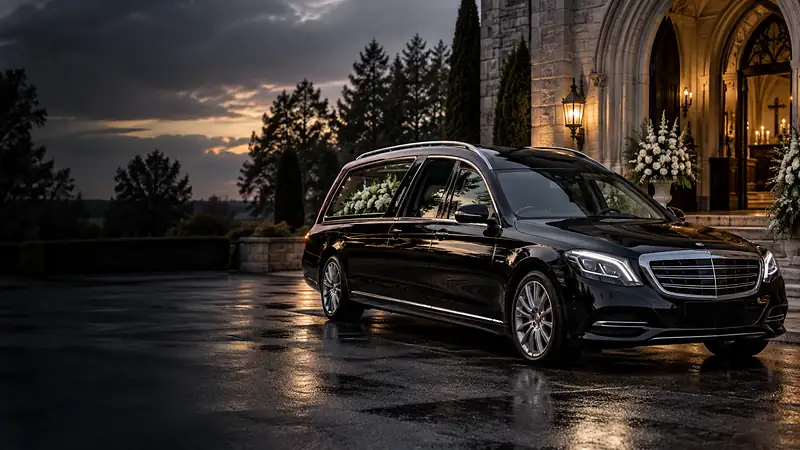
How to buy a funeral director business: due diligence and funding
Buying a funeral home usually means paying for goodwill tied to a trusted local name, plus premises with a mortuary and a fleet…

How funeral directors fund a hearse, limousine or private ambulance by hire purchase, leasing or refinance, with VAT, clean air zones and a worked example.
“The whole process was very smooth and was completed within a few days.”
In short
What you need to know.
Because funeral services are largely VAT exempt, the VAT on a hearse is usually a real cost that should be built into the comparison. New coachbuilt vehicles have long build times, so the finance is normally approved well before delivery. We arrange it as a broker, searching the whole market.
About hearse finance
Specialist knowledge. Better outcomes.
A hearse is the most visible asset a funeral director owns, and with a matching limousine it is often the most expensive purchase the firm makes outside its premises. Vehicle finance lets the business replace or add to its fleet from the income the vehicles earn rather than from reserves it may need for disbursements. Smart Funding Solutions is a broker, not a lender. We arrange finance from £10,000 to £20 million by searching the whole market, and this page is part of our funeral director finance section.
Lenders judge a vehicle by what it would fetch if they had to sell it, and funeral vehicles vary on that test.
Mortuary refrigeration, embalming equipment and chapel fit-outs are financed separately as equipment; see asset finance.
The arrangement of a funeral is largely exempt from VAT, so many funeral directors are not VAT registered, or are partly exempt because they also sell standard-rated items such as memorials and flowers. For most firms that means the VAT on a hearse is a real cost. On hire purchase it is payable at the outset, and some lenders will include it in the amount financed. On a lease it is spread across the rentals. A firm with meaningful taxable sales should ask its accountant how the partial exemption rules apply before choosing. On capital allowances, a hearse is a specialist vehicle rather than an ordinary car, and specialist vehicles are treated differently from cars, so ask your accountant how the rules apply to a hearse bought on hire purchase before you choose between the options; see asset finance and capital allowances for the general position.
Illustration only, with round hypothetical figures. A third-generation funeral director with two branches runs a hearse and limousine that are fourteen years old, and the city it serves is bringing in a clean air zone that the old diesels will not meet. It orders a new coachbuilt hearse at £130,000 plus VAT and a matching limousine at £110,000 plus VAT, with delivery in nine months. The purchase is arranged like this.
A five-year term on vehicles the firm will run for a decade keeps the repayments ahead of depreciation. Monthly figures depend on the lender and on the deposit, which is why we show firms more than one offer before they sign the coachbuilder's finance paperwork.
A new coachbuilt hearse has a long build time, so the finance is usually approved months before delivery and the agreement starts when the vehicle arrives. Used hearses and limousines from specialist dealers are a sensible route for a new firm or a second branch, and lenders will fund them, generally over a shorter term and with a larger deposit as the vehicle gets older. Age and mileage matter, and so does whether the vehicle meets the emissions standard for any clean air zone the firm works in, because a hearse that cannot enter the city centre has a weaker resale value. Like any other vehicle, a hearse needs an annual MOT once it is old enough, and a vehicle converted from a standard car may need approval through the GOV.UK vehicle approval process before it is registered, which a reputable coachbuilder handles. For older or unusual vehicles see used equipment finance.
Match the term to how long the firm will run the vehicle, and treat a balloon payment as a bill that falls due rather than as a saving. Check mileage limits and return conditions on a lease, because a hearse that is also used for removals can cover more miles than expected. If the firm is partly VAT exempt, make sure the VAT cost is in the comparison. A firm that finances its whole fleet and then wants to buy premises or another funeral home can find that lenders offer less, so tell your broker about the longer plan; see how to sell a funeral director business for how a fleet on finance looks to a buyer. If the firm's cash is tied up in disbursements rather than vehicles, a working capital loan may be the better tool.
trading as limited companies, partnerships or sole traders, replacing a vehicle or adding to the fleet as funeral numbers grow.
, where the next generation takes over and the fleet is refinanced or renewed as part of the change; see how to buy a funeral director business.
, where a used hearse is often the first large purchase. Lenders rely on the owner's industry experience, deposit and personal credit; see funeral home start-up finance.
Because the vehicle is good security, hire purchase is often available where an unsecured loan would not be; see asset finance with bad credit.
Lenders test affordability on the last two years of accounts, recent bank statements and existing commitments, and they normally ask for a personal guarantee from the owners. They also like to understand the firm's funeral numbers and how much of its work is paid through pre-paid plans, which is covered on the main funeral director finance page. Funeral directors are not licensed in England and Wales, although most belong to the National Association of Funeral Directors or the National Society of Allied and Independent Funeral Directors and follow their codes. Scotland has a statutory code of practice for funeral directors. Across the UK, the Competition and Markets Authority's funerals market investigation requires firms to display a standardised price list, which some lenders ask to see because it shows how the business charges for its vehicles.
How the main business finance structures work. Lenders set their own terms, so treat this as a guide to the questions to ask.
| Option | How you repay | Security | Often used for |
|---|---|---|---|
| Unsecured business loan | Fixed instalments, usually monthly | No charge over assets; a personal guarantee is usually required | Growth, stock, tax bills and cash flow |
| Secured business loan | Fixed instalments, often over a longer term | A charge over property or other assets | Larger sums, property and refinancing |
| Revolving credit facility | Interest on what you draw; repay and redraw | Varies by lender and case | Recurring or uneven cash flow gaps |
| Merchant cash advance | A share of future card takings | No charge over assets | Card-taking businesses with uneven months |
| Asset finance | Regular payments over the life of the asset | The asset being financed | Equipment, vehicles and machinery |
| Invoice finance | Settled as customers pay their invoices | Your unpaid invoices | Businesses waiting on customer payment |
General information only. Every lender has its own criteria, and all finance is subject to status.
| Option | Ownership | Suits | Watch for |
|---|---|---|---|
| Hire purchase | Yours after the final payment | A hearse or limousine you will keep for ten years or more | VAT on the full price at the start, and for most funeral directors it is not recoverable |
| Finance lease | The lender's, you rent it | Spreading the VAT across rentals and keeping upfront cost down | Secondary rental periods and the sale proceeds at the end |
| Operating lease or contract hire | The lender's, which takes the residual value risk | Firms that want to replace the fleet every few years | Mileage and return conditions, and the vehicle is never yours |
| Asset refinance | Yours, with a charge to the lender | Releasing cash from a paid-off fleet to fund premises or a second branch | Adds a monthly cost to vehicles that were costing nothing |
| Unsecured loan | Yours from the start | Livery, a deposit on a new build, or a private sale a lender will not secure | Needs a personal guarantee and a healthy trading record |
Our guides to hire purchase versus leasing and hire purchase versus a bank loan explain the mechanics. Rates, deposits and terms depend on the lender and the age of the vehicle. Balloon payments are common on vehicle agreements and are explained in our glossary entry on balloon payments.
Send us the quote and tell us about the fleet. We check how VAT affects the comparison for your firm, approach lenders across the market that fund funeral vehicles, and compare their terms with the coachbuilder's or dealer's own finance. The lender you choose pays the supplier on delivery. Any broker fee is disclosed before you proceed. For fleet purchases across other trades, our vehicle finance case study shows how an operator added several vehicles for new contracts before the revenue arrived. To see which lenders fit your firm, start with Instant Quotes and tell us the price of the vehicle.
Instant hearse finance quotes
Tell us how much you need. Instant Quotes shows which lenders on our panel fit your business, then a broker helps you choose between hire purchase, leasing and a loan.
Prefer to talk it through? Call 01244 267694
Usually, yes. Coachbuilt hearses keep a resale market among funeral directors, so lenders fund used examples from dealers and coachbuilders, though they may shorten the term and ask for a larger deposit on older vehicles. Have the age, mileage, registration and the seller's details ready.
Yes. Matching pairs are commonly placed on a single hire purchase agreement with one deposit and one monthly payment. Adding a removal vehicle on a shorter separate agreement is also common, because it will be replaced sooner.
Most funeral directors cannot, because the arrangement of a funeral is largely VAT exempt. A firm with taxable sales may recover part of it under the partial exemption rules. Where the VAT is a cost, compare hire purchase and leasing on the total you pay including VAT.
It is possible, usually for a used vehicle, with a larger deposit and evidence of the owner's experience in the trade. Lenders rely on the vehicle as security, the owner's personal credit and a short business plan. Our page on funeral home start-up finance covers the wider costs.
Yes. Lenders fund electric and hybrid hearses, and clean air zones are making them more common. Because the resale market is newer, some lenders ask for a larger deposit or a shorter term. Ask about charging equipment too, which can be funded alongside the vehicle.
The finance is approved on the order and the agreement starts on delivery, so you are not paying for a vehicle you do not have. Some coachbuilders ask for a deposit at order, which can be paid from cash or a short loan and then netted off the agreement.
Yes. Asset refinance or sale and leaseback borrows against vehicles you own outright, which suits a firm whose fleet is paid off but whose cash is tied up in disbursements or a new branch. See asset refinancing.
Buying a funeral home usually means paying for goodwill tied to a trusted local name, plus premises with a mortuary and a fleet…
Funeral home start-up funding usually combines a start-up or unsecured loan for fit-out and early running costs, asset finance…
Selling a funeral home usually means choosing between a group, a neighbouring independent or your own staff, then agreeing how…

Buying a pharmacy with a short lease is possible, but most lenders want the lease to run beyond the loan term, because the NHS…

Finance for NHS contracts covers the costs a provider incurs before payments start, such as recruitment, premises, equipment…

Setting up a small-animal veterinary practice commonly runs into the hundreds of thousands of pounds once you add premises…
What our clients say
“Simon was fast, kept us updated at all stages and was a real pleasure to work with on our asset finance. I highly recommend this company: excellent service all round.”
“Spoke with Simon, who managed to get me the loan I needed promptly. The whole process was very smooth and was completed within a few days.”
“Getting a business loan can feel like a bit of a minefield, but everything was broken down for me in great detail. Will use again in the future!”
“Simon was a pleasure to deal with and helped us find a business loan that matched our growth goals and future expansion plans.”
“I couldn’t source funding for my business, but the team got in touch within an hour and had it sorted within 24 hours. Fantastic service, and I would definitely use them again.”

Chat with Smart Funding
We usually reply in seconds
Please don't share bank details or passwords here. Calls on 01244 267694.