
Meat processing equipment finance for abattoirs, processors and butchers
Meat processing equipment finance funds saws, mincers, packing lines, chillers, blast freezers and refrigerated vehicles…
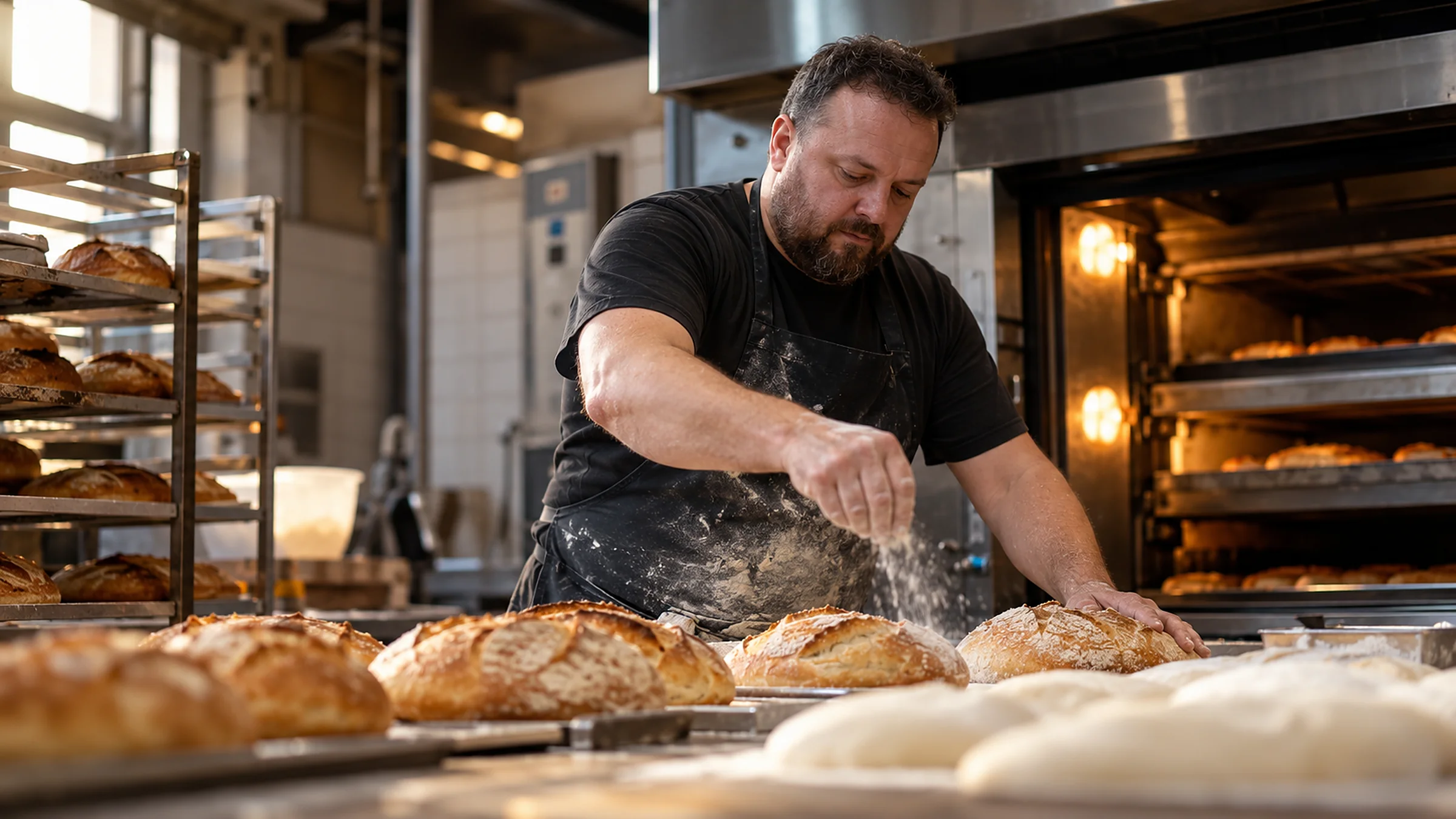
How bakery equipment finance works for ovens, mixers, provers and shop counters: what lenders check, documents needed, security and how costs are structured.
Explore funding options Prefer a quick call back? Leave your number
“He is fair and always gives advice that is in the best interest of his clients.”
In short
Supporting bakeries at every stage.
The equipment acts as the main security, often with a director's guarantee. Lenders look at trading history, bank statements, margins, food hygiene standards and the resale value of the kit before deciding.
Lenders are most comfortable with equipment that has a clear second-hand market and a long working life, and most bakery production kit fits that description. Typical items include:
Used equipment can be funded too. Many lenders will consider refurbished ovens and mixers from established dealers, subject to age, condition and an invoice that identifies the item clearly. Our page on used equipment finance covers what lenders check. The broader commercial kitchen equipment finance guide is useful if you also run a café or hot food counter.
The operating cycle
Cash leaves the business at every stage before it comes back. Each stage below is a point where the right facility can carry the gap.
“I highly recommend this company: excellent service all round.”
Orders, contracts or customers secured.
Stock, materials and equipment paid for up front.
Asset finance →Wages and suppliers paid on time.
Working capital →The work is done or the goods are sold.
Customers pay, sometimes weeks later.
Invoice finance →VAT and Corporation Tax fall due.
HMRC loans →Growth, a new site or new equipment.
Business loans →A transaction we arranged
£50,000
Declined by several lenders. £50K funded by the right one.
Existing borrowing and historic profit failed several lenders’ standard credit models. We took the case to a different lender and got it funded.
Read the transactionAbout bakery equipment finance
Specialist knowledge. Better outcomes.
This page is for craft bakers, wholesale bakeries, patisseries and bakery cafés that need to replace an oven, add production capacity, fit out a new shop or steady cash flow through a slow season. Bakery equipment finance spreads the cost of ovens, provers, mixers and shop counters over their working life instead of draining the bank account in one go. Smart Funding Solutions is a broker, not a lender. We approach lenders on our panel of 300+ that understand food businesses, arranging facilities from £10,000 to £20 million. For the wider picture across food production, see our food manufacturing finance page.
Choose the need, and we’ll show you how lenders usually structure it.
Bakery equipment finance lets a lender buy or fund the kit you need, while you repay in fixed monthly instalments and use the equipment from day one. The equipment itself usually acts as the main security, which is why it is often easier to arrange than an unsecured loan of the same size.
The two structures you will meet most often are:
Where the spend is mostly fit-out, building work or a mix of items that a lender cannot easily repossess and resell, an unsecured term loan or fit-out and refurbishment finance often sits alongside the equipment facility.
Bakery equipment finance suits trading bakeries with a clear use for the kit and the cash flow to meet a fixed monthly payment. It works well for:
It is a weaker fit for brand new start-ups with no trading history, where lenders usually want a larger deposit, a strong personal credit profile or additional security. It is also not the right tool for general losses: if the real problem is that the business is not covering its costs, more debt rarely helps. Our start-up business loans page explains the options for very new businesses.
For a single oven or mixer from a recognised supplier, decisions can come within a few working days in straightforward cases. Once approved, documents are signed and the lender pays the supplier, which then arranges delivery and installation.
A larger package, such as a full production line, a second shop fit-out or a mix of new and used equipment, typically takes longer, often a couple of weeks or more. Timescales depend on the lender, how complete the paperwork is, whether management accounts are up to date and how quickly the supplier can provide a final invoice. If your oven has failed and you are losing production, tell us at the start so we can approach lenders that suit urgent cases.
With hire purchase and leasing, the equipment is the primary security. The lender owns it, or holds legal title until the final payment, and can recover it if repayments stop. That is why lenders care about resale value and why specialist equipment from well-known manufacturers tends to be easier to fund than bespoke items.
Most lenders also ask limited company directors for a personal guarantee, especially for younger businesses or larger amounts. A deposit may be requested where the business is new, the equipment is used or the credit profile is mixed. An unsecured loan for fit-out costs will almost always come with a personal guarantee. Read our guide to personal guarantees before you sign one.
The cost of bakery equipment finance is usually built from a few parts, and it is worth comparing all of them rather than the monthly payment alone:
Our asset finance calculator lets you test different terms and deposits. Your accountant can advise on capital allowances, which depend on the structure you choose.
If equipment finance is not the right fit, several other routes can fund a bakery:
Our general business equipment financing page compares these options across sectors.
Lenders assess whether the bakery can afford the repayments, whether the equipment holds its value and whether the people behind the business are reliable. In practice they look at:
How long you have traded, recent turnover and whether profits are stable or recovering.
Daily takings, card receipts, regular wholesale payments and how the account behaves through quieter months.
Flour, butter, energy and labour costs have a large effect on bakery margins. Lenders like to see that prices have been reviewed when costs rose.
A wholesale bakery that depends on one or two large customers is a bigger risk than one with many smaller accounts.
Your local authority registration and food hygiene rating. A poor rating or open enforcement issue can stop an application.
Its cost, age, supplier and resale value, and whether it will be installed in premises you have a secure lease on.
The business and directors' credit records, including any missed payments, CCJs or arrears with HMRC.
Food businesses must be registered with their local authority before they start trading, and the gov.uk food business registration page explains how. Lenders may ask for confirmation, particularly on a new site.
For a straightforward bakery equipment application, lenders usually ask for a short set of documents. Larger or more complex requests need more.
Having these ready before an application goes in is the single easiest way to shorten the process.
Equipment finance is often the most efficient way for a bakery to fund production kit, but it has trade-offs.
The nearest alternative to equipment finance is an unsecured business loan, and the right choice depends mainly on what you are buying.
| Feature | Equipment finance (HP or lease) | Unsecured business loan |
|---|---|---|
| Best for | Ovens, mixers, provers, counters, vans | Fit-out, building work, marketing, mixed spending |
| Security | The equipment itself, often plus a guarantee | Personal guarantee; no specific asset |
| Who pays the supplier | The lender pays the supplier directly | Funds paid to your account |
| Typical term | Matched to the equipment's working life | Often shorter, set by the lender's appetite |
| Effect on cash flow | Spreads the cost; VAT treatment depends on structure | Spreads the cost; full flexibility on use of funds |
| Ownership | Yours at the end of HP; lender's on a lease | You own whatever you buy |
Many bakeries use both: equipment finance for the production kit and a smaller unsecured business loan for the building work around it.
We start by understanding what you want to buy, why, and how it pays for itself, whether through more output, lower labour, less waste or a new site. We then approach lenders on our panel that fund food production equipment and present your case clearly, including any history that needs explaining. In one completed case, we arranged £50,000 for a bakery after other lenders had declined, which shows that a refusal from one lender is not always the final answer.
We compare the offers with you, including deposit, term, guarantees and end-of-term options, and lenders make every credit decision. It is free to enquire; any broker fee is disclosed separately before you proceed.
Sometimes. Lenders prefer used equipment bought from a dealer who provides an invoice and confirms the item is free of existing finance. A private sale between two bakeries is harder, because the lender has to verify ownership, condition and value. A finance check on the item and an independent valuation can help an application along.
Some lenders will add a modest amount of installation cost to the equipment agreement, particularly where the supplier invoices it together with the oven. Larger items such as gas supply upgrades, three-phase electrics or extraction canopies are usually treated as fit-out and funded separately, often through an unsecured loan or refurbishment facility.
Repayments continue regardless of whether the equipment is working, so maintenance and breakdown cover matter. Check the manufacturer's warranty, consider a service contract and make sure the equipment is insured for loss and damage, which most lenders require as a condition of the agreement anyway.
Yes, but it is usually arranged as part of the wider purchase. Lenders look at the trading record of the bakery being bought and your own experience. Existing equipment may already be on finance, which needs settling or transferring. Acquisition finance and asset refinancing can sometimes be combined to fund the deal.
It can. Bakeries often see peaks around Christmas, Easter and summer events, with quieter spells in between. Lenders review bank statements across the year, so explaining seasonal patterns in advance helps. Some lenders can offer seasonal or stepped payment profiles that ask for less in the quieter months.
Yes. Buying an established bakery is usually funded with acquisition finance: a loan sized on the business's recent profits, your own contribution and sometimes part of the price paid to the seller after completion. Lenders look most closely at the wholesale and shop customers, the ovens and production equipment, food safety records and the lease. You can see which lenders on our panel fund purchases like yours with Instant Quotes.
Meat processing equipment finance funds saws, mincers, packing lines, chillers, blast freezers and refrigerated vehicles…

To open a day nursery in England you need premises with enough indoor and outdoor space for the EYFS requirements, a qualified…

To open a padel club, test local demand, choose between an indoor unit and an outdoor site, secure planning consent and a lease…

To open an indoor golf centre, test local demand, find a unit with enough ceiling height and space for your bays, check…
How a sports business is funded depends mostly on whether it is a commercial business or a community club. Commercial venues,…

Lease the gym kit that dates and buy the kit that lasts. Cardio machines with screens and software usually suit an operating…
What our clients say
“Simon was fast, kept us updated at all stages and was a real pleasure to work with on our asset finance. I highly recommend this company: excellent service all round.”
“Spoke with Simon, who managed to get me the loan I needed promptly. The whole process was very smooth and was completed within a few days.”
“Getting a business loan can feel like a bit of a minefield, but everything was broken down for me in great detail. Will use again in the future!”
“Simon was a pleasure to deal with and helped us find a business loan that matched our growth goals and future expansion plans.”
“I couldn’t source funding for my business, but the team got in touch within an hour and had it sorted within 24 hours. Fantastic service, and I would definitely use them again.”