

Development exit finance for completed homes and commercial schemes
Development exit finance is a short-term loan taken at or near practical completion to repay the development lender, giving the…
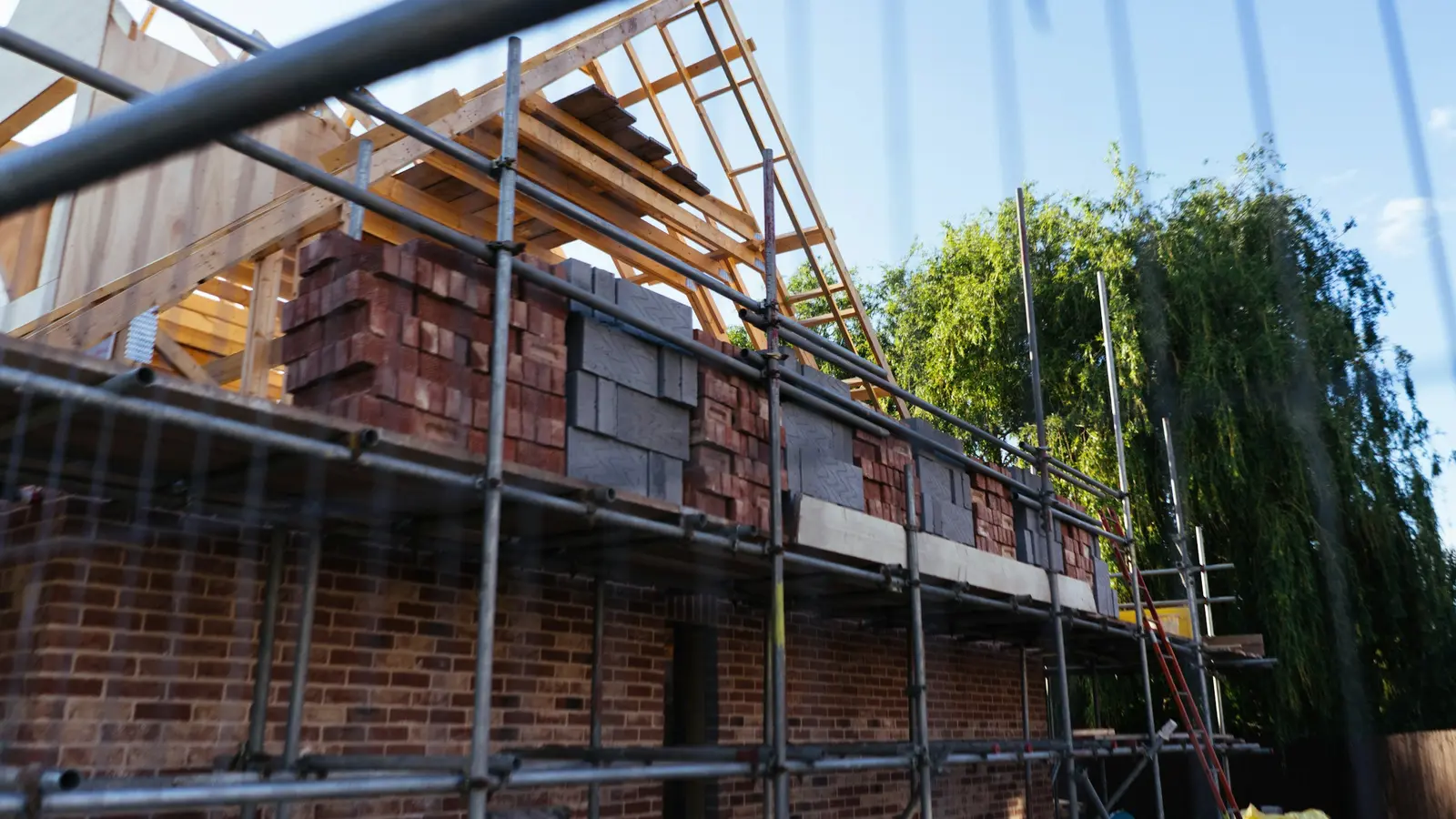
How developers refinance a stalled housing, commercial or mixed-use build after cost overruns, contractor failure or an expired facility.
Explore funding options Prefer a quick call back? Leave your number
“The whole process was very smooth and was completed within a few days.”
In short
What you need to know.
A new lender refinances the existing debt and funds the remaining build in stages. Lenders focus on an independent cost-to-complete report, the scheme's value as it stands and the credibility of the exit.
About development continuation finance
Specialist knowledge. Better outcomes.
This page is for companies and developers with a residential, commercial or mixed-use scheme, whether a row of new houses, a small block of flats, trade counter units or a retail parade with flats above, whose build has stalled or whose current facility no longer covers what is left to do. Smart Funding Solutions is a broker, not a lender: we search our panel of 300+ lenders, including specialist development and bridging funders, for facilities from £10,000 to £20 million. It sits within our property development finance section. One boundary applies: we stay out of regulated lending, meaning any loan secured on a property that you or a family member occupies or intends to occupy, and we do not place mortgages for buy-to-let, HMO or holiday-let investors.
A development loan is sized against a cost plan and a programme agreed before the first spade goes in. When either moves far enough, the facility stops matching the project. The usual triggers are:
Before looking for new money, put a costed proposal to your current lender. An extension of the term, a modest increase in the facility or a standstill while you resolve a contractor problem is usually cheaper than a refinance, because there is no new valuation, no second set of legal fees and no early redemption cost. Lenders often prefer a workable plan to enforcing against a half-built site, which they would then have to finish or sell at a discount.
If the answer is no, ask for a redemption statement early. It shows the true figure a new lender must clear, including rolled-up interest, any default interest, exit fees and the lender's own costs. That number frequently comes as a surprise, and it decides whether a rescue refinance is possible at all. Where a second-charge lender sits behind the senior loan, its consent and its own redemption figure are needed too.
Illustration only, with round hypothetical figures. A developer is building six trade counter units with an expected completed value of £3,000,000. The main contractor fails with the steel frame up and the roof partly clad. The existing lender's redemption figure is £1,500,000 including rolled-up interest. A replacement contractor prices the remaining work at £800,000 against £500,000 left in the original budget, because some completed work has to be redone and a new contractor carries more risk.
A rescue lender looks at the £2,300,000 needed (redemption plus cost to complete) and adds its own fees and a contingency. If it will lend £2,000,000 against the scheme, the developer must find the balance from cash, a second charge over another property or a partner. The scheme still makes a profit, but a smaller one, and the arithmetic only works because the completed value comfortably exceeds the total debt.
Rescue money is priced for a project that has already gone wrong once, so it costs more than the original facility, and personal guarantees are close to universal. The real risk is putting further money into a scheme whose completed value no longer covers the total debt: a refinance then only delays a larger loss. Test the numbers on a conservative completed value before committing.
Do not sign a replacement building contract before the new lender's surveyor has reviewed it, as a contract the lender will not accept can delay the refinance. If your contractor has failed, check its status through the GOV.UK guidance on checking whether a company is being liquidated and the Companies House register before paying anything further. Where a lender has already appointed receivers, options narrow quickly, so early contact matters. Our guide to fixed and floating charges explains how competing security ranks.
a quantity surveyor's report on the work done, its quality and the realistic cost of finishing, not the developer's own estimate.
a clear account of whether the cause was a one-off event, such as a contractor collapse, or a weakness in planning and cost control.
its financial standing, a fixed-price contract for the remaining work and who will stand behind defects in work the failed contractor carried out. On homes for sale, the lender also wants the structural warranty provider to confirm it will still insure the plots, because buyers' mortgage lenders rarely lend without that cover.
a fresh valuation of the site as it stands and of the finished scheme, since a lender rescuing a project must be covered if it fails a second time.
plot reservations and local new-build sales evidence for houses and flats, or pre-lets and heads of terms for commercial space, showing the finished units will sell or let promptly.
how much of your own money is still at risk, and any further cash or security you can add.
unpaid subcontractors, retentions and disputes that could cloud title or delay the build.
How the main business finance structures work. Lenders set their own terms, so treat this as a guide to the questions to ask.
| Option | How you repay | Security | Often used for |
|---|---|---|---|
| Unsecured business loan | Fixed instalments, usually monthly | No charge over assets; a personal guarantee is usually required | Growth, stock, tax bills and cash flow |
| Secured business loan | Fixed instalments, often over a longer term | A charge over property or other assets | Larger sums, property and refinancing |
| Revolving credit facility | Interest on what you draw; repay and redraw | Varies by lender and case | Recurring or uneven cash flow gaps |
| Merchant cash advance | A share of future card takings | No charge over assets | Card-taking businesses with uneven months |
| Asset finance | Regular payments over the life of the asset | The asset being financed | Equipment, vehicles and machinery |
| Invoice finance | Settled as customers pay their invoices | Your unpaid invoices | Businesses waiting on customer payment |
General information only. Every lender has its own criteria, and all finance is subject to status.
| Route | When it suits | Trade-off |
|---|---|---|
| Refinance-and-complete development loan | The scheme is sound and the remaining work is well defined; a new lender clears the existing debt and funds the remaining build in stages | Fresh valuation, monitoring and legal costs; pricing reflects the history of the project |
| Bridging loan, then development finance | The existing loan must be cleared urgently, before a full development facility can be underwritten | Two sets of fees; a bridging loan is costly if the second step slips |
| Second-charge top-up | The senior lender will stay in and agree to a junior loan covering the overrun | Mezzanine finance costs more and needs an intercreditor agreement |
| Additional security | The company or its directors own other business or investment property with equity in it | A secured business loan puts that property at risk if the scheme fails |
| Joint venture partner | The gap is large relative to your own resources | You give up a share of profit and some control |
| Sell the site as it stands | The cost to complete exceeds what the finished scheme will add | Crystallises a loss, but stops interest compounding |
Where the build is largely finished and only snagging, fit-out or sign-off remains, the cheaper answer may be to move straight to development exit finance rather than a fresh build facility.
If your scheme involves converting an existing building rather than building new, see our page on conversion finance. When you have the redemption figure and a cost-to-complete report, you can send us the details online.
Illustrative figures from the numbers you enter, before you speak to a lender.
Often, yes. Rescue lenders expect to see a default notice or an expired term; what matters is whether the completed scheme is worth enough to cover the redemption figure, the cost to complete and the new lender's costs. Default interest can add materially to the redemption figure, so the sooner you start, the more equity is left to work with.
The new facility has to clear the full redemption figure, including rolled-up and default interest, so yes, in the sense that it is included in what is borrowed. That increases the debt the scheme must carry. Some developers negotiate a reduction of default interest with the outgoing lender as part of a clean exit.
Collateral warranties and the contractor's defects liability may be of little practical value once it is insolvent. Lenders and future buyers will want a replacement contractor to take responsibility for the work it completes and a surveyor's report on the earlier work. On a housing scheme the structural warranty provider will usually inspect before agreeing to continue cover, and may ask for opening-up works; for commercial buildings, latent defects insurance is sometimes arranged to fill the gap, at a cost.
Yes. Part-built houses and flats for sale are funded on the same principles as other stalled schemes. On a site of several homes, lenders often favour finishing and selling the most advanced plots first, so that early sales pay down the debt before the remaining plots are completed. Expect close attention to local new-build prices and to the structural warranty position.
It depends mainly on how quickly an independent cost to complete report, a fresh valuation and the existing lender's redemption statement can be produced. These checks cannot be skipped, because a rescue lender must be covered if the scheme fails a second time. Having a replacement contractor on a fixed-price contract, an updated programme and the redemption figure ready speeds things up. Where the existing loan must be cleared urgently, a bridging loan can come first, followed by development finance.
Instant Quotes shows which lenders on our panel are likely to fit your scheme, with no credit search. Continuation finance is then priced case by case after a monitoring surveyor's report and valuation.
Development exit finance is a short-term loan taken at or near practical completion to repay the development lender, giving the…

Permitted development finance funds buying and converting a building whose new use needs no full planning application: offices…

Commercial property finance is borrowing secured on business property: offices, industrial units, shops, trading premises and…

A loan to buy business premises is usually an owner-occupier commercial mortgage, repaid from the profits of the business that…

A commercial mortgage is a long-term loan secured on business property, used to buy, hold or refinance offices, industrial…
A commercial investment mortgage is long-term borrowing secured on a building let to business tenants and repaid from the rent…
What our clients say
“Simon was fast, kept us updated at all stages and was a real pleasure to work with on our asset finance. I highly recommend this company: excellent service all round.”
“Spoke with Simon, who managed to get me the loan I needed promptly. The whole process was very smooth and was completed within a few days.”
“Getting a business loan can feel like a bit of a minefield, but everything was broken down for me in great detail. Will use again in the future!”
“Simon was a pleasure to deal with and helped us find a business loan that matched our growth goals and future expansion plans.”
“I couldn’t source funding for my business, but the team got in touch within an hour and had it sorted within 24 hours. Fantastic service, and I would definitely use them again.”